How to Find Affordable Alternatives to Pricy Kitchen Tools
Homepage How to Find Affordable Alternatives to Pricy Kitchen Tools
Last Updated: October 30, 2026
Quick Summary
You can find affordable alternatives to expensive brand name kitchen tools by checking materials and construction instead of logos, spending on tools that touch heat or take daily abuse, and saving on simple basics. Open-box and overstock items that are tested and inspected before listing offer another route to lower prices.
Spend on a chef’s knife, cutting board, and Dutch oven; save on spatulas, tongs, mixing bowls, and measuring cups.
Match food processor bowl size to your task: 3- to 7-cup for light chopping, 9- to 11-cup for batch prep.
Check that the maker sells replacement bowls, lids, and blades, and read the warranty terms before buying.
Upgrade to electric only when the task is frequent and the time savings are real; stay manual for occasional jobs.
At The Wise Buy, every item is tested and inspected before listing, with photos and a full condition description.
Why Brand-Name Kitchen Tools Cost More Than They Should
Walk down any kitchen aisle and you will notice the pattern: two spatulas that look nearly identical, one carrying a familiar logo and a much higher tag. Understanding that gap is the first step toward finding real alternatives to expensive brand name kitchen tools. Knowing where the markup lives helps you spend on performance instead of packaging, and it keeps more money in your kitchen budget for the tools that actually matter.
How to Spot Quality Kitchen Tools Without the Brand Markup
Quality shows up in materials and construction, not logos. A good kitchen tool feels solid in the hand, resists flex, and cleans up without fuss. Look for these signals:
Stainless steel with visible weight, not thin stamped metal
Wood or bamboo handles joined securely, with no gaps at the rivet
Silicone that stays firm at high heat instead of softening
Seams that sit flush, so food does not catch in crevices
Before you buy, read the material list and check the joints yourself. For a deeper set of buying tactics, our guide on tips for buying discounted kitchen gadgets in 2026 walks through what to check in person and online.
Essential Kitchen Tools for Beginners: Where to Save and Where to Spend
Beginners need a short list, not a drawer full of gadgets. Spend where the tool touches heat or takes daily abuse. Save where a simple version does the same job.
Tool
Where to spend or save
Why
Chef’s knife
Spend
Edge retention and balance matter daily
Cutting board
Spend
A stable wood or bamboo board protects knives
Dutch oven
Spend
Heat retention and durability pay off for years
Spatula and tongs
Save
Silicone and stainless basics work fine
Mixing bowls
Save
Stainless or glass sets cover most tasks
Measuring cups
Save
Accuracy comes from the markings, not the brand
Many beginners find that a modest set of essential kitchen tools for beginners covers nearly every recipe. The knife and the pot are the two places a cheaper option usually shows its limits fastest.
Finding the Best Food Processor Without the Premium Price Tag
The best food processor is the one that matches your actual cooking, not the one with the loudest ad campaign. A processor earns its place through motor strength, bowl capacity, and how easy the parts are to clean. Shredding cheese, chopping vegetables, and mixing dough each put different demands on the machine, so the right pick depends on which of those you do most.
Match the machine to the job
Light chopping, sauces, and dips: a compact 3- to 7-cup bowl with a single S-blade covers most of it. Smaller bowls are easier to store and quicker to wash, which matters more than raw wattage at this level.
Batch prep and shredding: step up to a 9- to 11-cup bowl with a reversible shredding disc and a slicing disc. This is the size most households land on, and it handles dough for a single loaf without straining.
Dough, large batches, and family cooking: a 12- to 14-cup bowl with a dough blade and a wide feed tube. The wide tube saves real time because you stop quartering onions and potatoes before they go in.
What the price actually buys
A higher price often buys extra attachments you will rarely use, a heavier base, and a longer warranty. The motor and the bowl are where the money should go. Compare these points before you decide:
Wattage relative to your heaviest task. Light chopping runs fine on a lower-wattage motor; kneading dough and shredding hard cheese need more torque, and a weak motor will stall or heat up.
Bowl material. Clear plastic is light and cheap but scratches and can stain; a thicker bowl resists cracking and holds up to hot ingredients better.
Feed tube width. A narrow tube means more pre-cutting. A wide tube is one of the most underrated features on a processor.
Blade and disc count. Two or three well-chosen discs beat a stack of specialty blades that sit in a drawer.
Dishwasher-safe parts and no deep crevices. Cleanup is where cheap processors show their age, because food trapped under the blade hub is hard to remove.
Where the savings hide
Before you buy, check whether the maker sells replacement bowls, lids, and blades, and read the warranty terms.
A higher price often buys extra attachments you will rarely use. Our roundup of the best places for discounted kitchen appliances covers where to look for a capable processor at a lower cost.
Pro Tip Bring your heaviest task to the decision. If you mostly chop onions and make hummus, a compact bowl is enough. If you knead dough weekly, pay for torque and a dough blade, not for a bigger attachment box.
Open-Box Kitchen Appliances: Real Value or Hidden Risk?
Open-box kitchen appliances can deliver savings, but the value depends on how carefully the item was checked before resale. An open-box unit is a product returned by a previous buyer or pulled from a shelf, then inspected and resold. The risk is real when a seller skips the inspection. The reward is real when the inspection is thorough.
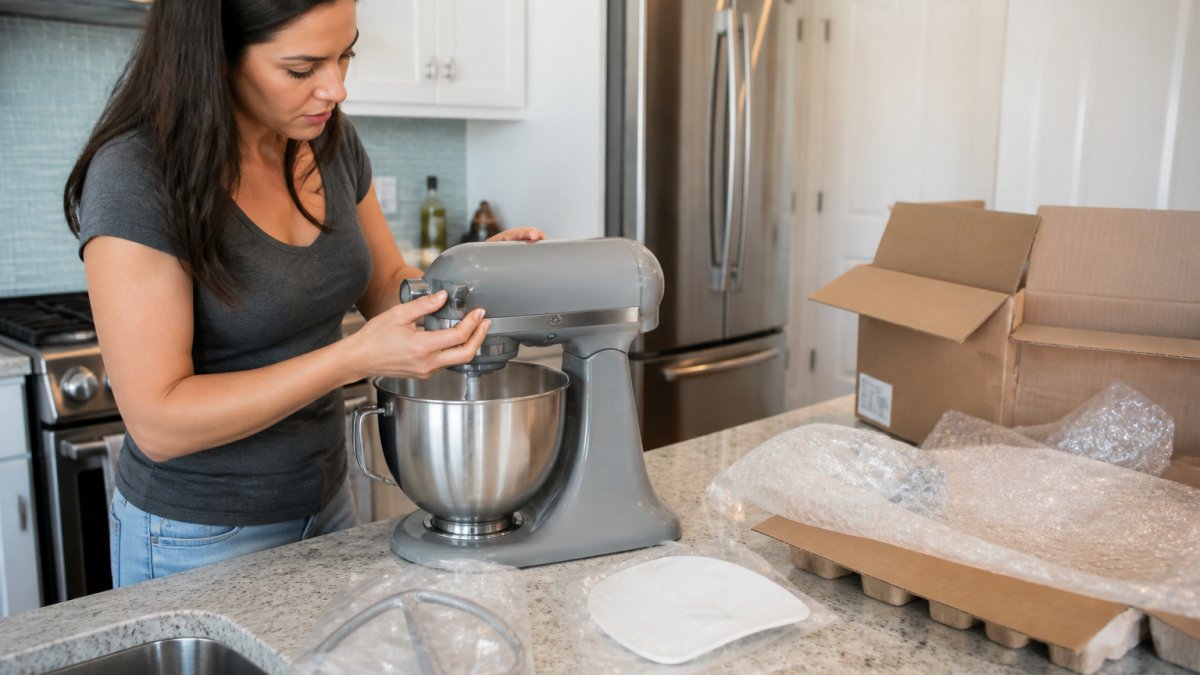
Person inspecting an open-box stand mixer and other kitchen tools on a bright home countertop
At The Wise Buy, every item is tested and inspected before it is listed, and each posting includes detailed photos and a full condition description. We are online only, so review those pictures and the condition notes on the posting before buying. For a broader look at whether these units make sense, read our guide on whether open box appliances are worth buying, and use our inspection checklist for open box appliances before you commit.
Manual vs. Electric: Which Kitchen Gadgets Are Worth the Upgrade
Electric appliances win on speed and repetition. Manual tools win on control, storage, and repair. A hand-cranked can opener never needs a cord. A manual whisk gives you feel that a stand mixer cannot. The upgrade is worth it when the electric version saves real time on a task you do often, and when the manual version would cost you more in effort than the appliance costs in money and counter space.
The trade-off, task by task
Worth the upgrade: a blender for daily smoothies, a food processor for batch prep, an electric kettle for frequent tea and pour-over. These save minutes on tasks you repeat, and the time adds up over a week.
Skip the upgrade: electric can openers, novelty slicers, single-task gadgets that crowd the counter. A manual can opener is small, cheap, and rarely fails; the electric version adds a cord and a motor for a job that takes seconds by hand.
Depends on volume: a stand mixer versus a hand mixer. For occasional cakes, a hand mixer is enough. For weekly bread or big batches of cookies, the stand mixer earns its footprint.
The durability angle competitors skip
Manual tools have fewer parts to fail, and most can be repaired with a screwdriver. That makes them the lower-risk choice for tools you use rarely. Electric appliances concentrate their value in the motor, and the motor is also what fails first. When you compare a premium electric appliance with a lower-cost one, ask two questions: does the maker sell replacement parts, and how long is the warranty? A cheaper unit with available parts and a real warranty can outlast a discounted premium unit with neither.
Total cost of ownership
Upfront price is only part of the math. A versatile manual tool often replaces three unitaskers, which saves money and cabinet space at once. An electric appliance that sits unused because it is a hassle to clean is a false economy no matter what it cost. Before you upgrade, estimate how often you will actually use the tool, whether it fits your storage, and whether the parts are dishwasher-safe. If the answer to any of those is no, the manual version is usually the better buy.
Key Takeaway Upgrade to electric when the task is frequent and the time savings are real. Stay manual when the task is occasional, the tool is simple, or the appliance would live in a cabinet.
Building a Budget-Friendly Kitchen Tool Collection at The Wise Buy
Building a collection is a project, not a single purchase. Start with the essentials, add versatile tools as your cooking grows, and replace only what breaks. The Wise Buy offers open-box and overstock kitchen appliances and tools, each tested and inspected before listing. Because we are online only, every posting carries photos and a full condition description so you can judge the item before you buy. For more on where to find cheap brand-name goods, see our guide to buying cheap brand name goods. Create an account with The Wise Buy and start building a kitchen that works hard without the premium markup.
Frequently Asked Questions
Are expensive kitchen tools actually worth the money?
Not always. A higher price often reflects brand marketing, packaging, and retail markup rather than better materials or performance. Many mid-range kitchen tools use the same stainless steel, silicone, or bamboo as premium brands. The difference shows up in warranty length and finish details, not core function. Focus on material quality, weight, and how a tool feels in your hand rather than the logo on the handle.
What are the best budget-friendly alternatives to high-end kitchen brands?
Look for store-brand or lesser-known brands that use the same materials: stainless steel knives with full tangs, silicone spatulas with steel cores, and cast iron skillets from smaller foundries. Compare specs like motor wattage and blade material instead of brand names.
How can I tell if a kitchen tool is high quality without the brand name?
Check the materials and construction. Stainless steel should be magnetic (indicating a grade that holds an edge), knives should have a full tang running through the handle, and silicone should be food-grade and heat-resistant. Look for weight and balance in your hand, tight seams, and riveted handles. Read the product description and photos carefully, especially for open-box items where condition details matter.
Is it better to buy open-box appliances or budget brands?
Budget brands can work well for simple tools like spatulas and mixing bowls. Always review the condition notes and photos before buying.
The gap between a premium logo and a solid tool is smaller than most shoppers think. The Wise Buy helps you close it with tested, inspected open-box and overstock items, detailed photos, and honest condition descriptions on every posting. Create an account with The Wise Buy and shop kitchen tools that deliver real value.

 Add more eligible items to your cart to unlock free shipping.