What Open-Box Condition Means and Why Appliances Get Sold This Way
Learning how to inspect open box appliances starts with understanding what the phrase “open box appliances” means. An open-box appliance was unboxed, returned, or displayed, then resold at a discount after inspection. It is not the same as a used appliance, and it is not automatically damaged.
So why do retailers sell appliances this way? A few common reasons:
Customer returns. The buyer changed their mind, found a better fit, or ordered the wrong size.
Cosmetic damage in transit. A scratch, dent, or crushed corner that never affects how the unit runs.
Display models. Floor units that were plugged in, demonstrated, and then cleared out.
Overstock. Extra inventory that was never opened at all, but is priced to move.
The discount exists because the box is gone, not because the machine is broken, which is why careful inspection protects your money.
Open-Box vs. Scratch-and-Dent vs. Refurbished: What’s the Difference?
These three labels get used interchangeably, causing real confusion:
Open-box: Unboxed or returned, usually tested, often with little or no cosmetic damage. The original packaging may be missing.
Scratch-and-dent: Sold specifically because of visible cosmetic damage. The scratch or dent is the reason for the markdown, and the unit should still function.
Refurbished: Previously used or defective, then repaired to working order. Repairs may be manufacturer-authorized or done by a third party.
The label tells you what to expect. An open-box item with a flawless exterior is a different buy than a scratch-and-dent unit with a dented door, so read the condition notes carefully, that is where the real story lives.
Your Open-Box Appliance Checklist: What to Bring and What to Look For
A good open-box appliance checklist turns a stressful purchase into a five-minute routine. Bring the right tools and inspect in a logical order to catch problems most buyers miss.
Tools and Documents to Bring to the Inspection
You do not need a workshop. A small kit covers almost everything:
A flashlight or phone light for dark corners and coils
A tape measure to confirm the unit fits your space
The listing photos and description, printed or on your phone
A notepad or phone for notes and serial numbers
A small level if you are checking a range or dishwasher
If you are buying online, this same list applies to reading the posting. Our photos and condition notes answer these questions before you add an item to your cart.
The 50/50 Rule: When to Walk Away
Here is a simple rule: if you cannot confirm that at least half of the unit’s key functions work, walk away.
Walk away if you find:
A cracked drum, bent housing, or crushed coils
Any smell of gas or burnt wiring
A control panel that will not power on
Missing parts that are expensive or hard to source
A seller who will not put the condition and return terms in writing
A discount is only a deal if the appliance works.
Step-by-Step: Inspecting Every Major Appliance Type
Each appliance has its own weak points, and the parts that fail most often are rarely the ones buyers check first.
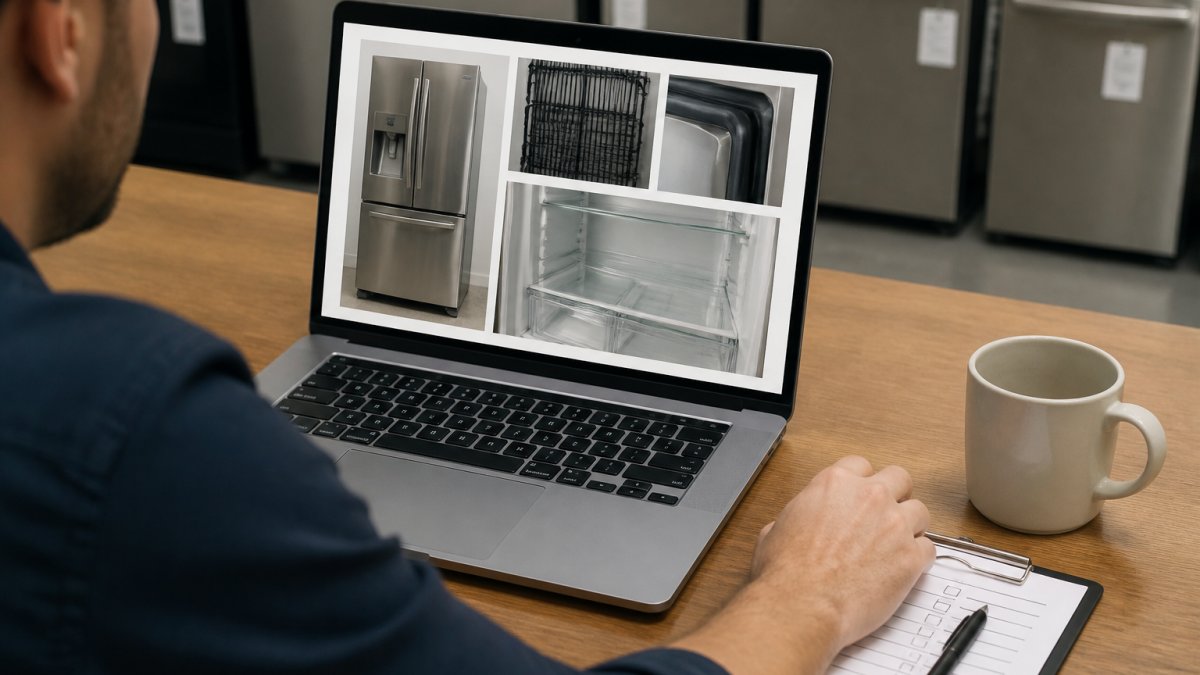
A person reviewing a laptop screen showing an open-box refrigerator listing with close-up photos of the condenser coils, door gasket, and interior shelves, with a printed checklist and pen on the desk
Refrigerators: Coils, Compressor, and Door Seals
Start with the condenser coils, usually behind a kick plate or across the back.
Check the door gaskets for a consistent, unbroken seal line in the photos; a cracked or peeling gasket lets cold air escape and forces the compressor to run longer.
What you can verify from the listing: coil condition, gasket appearance, shelf and bin inventory, interior stains or cracks.
Washers and Dryers: Drum Damage, Hoses, and Gas Connections
For top-load washers, look for rust or pitting around the tub rim and under the lid, a sign of a unit that sat in a damp environment.
On dryers, the drum should turn freely by hand with no grinding. Check the lint screen housing and duct connection for crushed or torn flex duct.
What you can verify from the listing: drum and boot condition, rust, hose and duct appearance, control panel completeness.
Ranges, Ovens, and Cooktops: Control Panels and Ignition
A dead or partially dead control panel is one of the most expensive range repairs, so scrutinize photos of the display and buttons for cracks, discoloration, or missing knobs.
On induction cooktops, confirm the surface is free of chips or cracks and the pan-size markings are legible. Check the oven gasket for tears and the racks for missing or bent tines.
What you can verify from the listing: panel and knob condition, burner cap inventory, glass integrity, oven gasket and rack condition.
Dishwashers and Microwaves: Door Latches and Interior Condition
On a dishwasher, check the door latch and hinge first, a unit that will not latch will not run, and a sagging door usually means worn hinges.
On a microwave, inspect the door seal and interior for burn marks, arcing scars, or chipped lining.
What you can verify from the listing: latch and hinge condition, interior rust and coating, rack and accessory inventory, door seal integrity. What usually requires installation: wash and dry cycles, drain and fill function, and microwave heating performance.
Pro Tip Build a short list of the functions you cannot confirm from the listing, cooling, heating, spinning, washing, and ask the seller to document them in the condition description.
A Quick Testing-Limit Rule
Not every function can be tested before installation. Separate what you can confirm from what you cannot, and price the unknown into your decision.
How to Read Open-Box Appliance Photos and Description Before You Buy
The listing is your first inspection. Good open-box appliance photos and description should show the unit from every angle, including the back and any flaws. When you shop online, look for:
Clear shots of the front, sides, back, and interior
Close-ups of any scratch, dent, or scuff
A written condition note that names the damage plainly
The model number and a list of what is included
At The Wise Buy, we photograph each item and describe its condition in full on the posting, so you can judge the unit before it ships. If a listing hides flaws or uses vague words like “as-is” with no detail, treat that as a warning sign.
Open-Box Appliance Missing Parts: What Should Be in the Box
Missing parts are the most common surprise with open-box buys. Before you pay, confirm what comes with the unit:
Power cord and plug
Hoses, connectors, and mounting hardware
Shelves, racks, and drawers
Owner’s manual and registration card
Any adapters or accessories shown in the listing
If a part is missing, ask what it costs to replace. A missing rack is cheap; a missing control knob or proprietary hose can be a headache. Get the answer in writing before you buy, and check that the parts list matches what the listing promised.
Open-Box Appliance Warranty, Returns, and Serial Number Checks
Warranty coverage is where open-box buyers get tripped up most, and a few minutes of verification prevents most disputes. Work through the three checks below before you buy.
1. Confirm the Warranty Clock and What It Covers
Many manufacturers start the warranty clock at the original sale date, not your purchase date, so an open-box unit may have far less coverage than new, sometimes none. Ask two questions and get the answers in writing:
Does the manufacturer warranty still apply, and on what date did it start?
Does the seller’s return policy cover functional problems, and for how long?
A common pattern is a manufacturer warranty that transfers but is shortened, plus a seller return window measured in days. Note both deadlines.
2. Run the Serial Number and Recall Check
Find the model and serial number, usually on a rating plate behind the kick plate, inside the door frame, or on the back panel, and write both down. Then:
Look up the model on the manufacturer’s site to confirm the production year and whether the warranty is still active.
Check the serial number against open recalls through the manufacturer or a government safety database.
Confirm the unit is not a floor display or a previously repaired unit unless the listing says so.
A recall check takes minutes and and can flag a fire, burn, or shock hazard no visual inspection would catch.
3. Document Everything in Writing
Before you pay, make sure the posting or sales paperwork records:
Any disclosed defects, with the specific location and severity
The full list of included parts and accessories
The warranty terms and start date
The return deadline and what it covers
Keep a copy of the listing, the condition description, and any messages with the seller. If a dispute arises, that record is your proof of what was promised.
Watch Out If a seller will not share the serial number or put the warranty and return terms in writing, that is a red flag. Without those details, you have no proof of what you were promised if something goes wrong.
4. Weigh the Discount Against the Risk
A simple framework: add up the likely cost of one repair, any missing parts, and the value of the coverage you are giving up. Use the listing’s photos and full condition description to judge the remaining unknown risk.
Delivery-Day Inspection: What to Check Before You Sign
Your inspection does not end at checkout. When the appliance arrives, check it again before you sign anything.
Photograph the packaging before you open it, especially any dents or tears
Unbox the unit and look for new damage that happened in transit
Confirm all parts and accessories are present
Test the basic functions if you can
Note any damage on the delivery paperwork before signing
That last step matters: once you sign a clean delivery receipt, it becomes much harder to prove damage happened in transit. Take photos, write down what you see, and keep a copy of everything.
Conclusion: Inspect Smart, Buy with Confidence
Inspecting an open-box appliance comes down to a few habits: check the parts that fail most, confirm what is included, and get the warranty and return terms in writing. Do that, and you can capture real savings without the risk.
At The Wise Buy, we do the heavy lifting for you. Every item is tested and inspected before it is listed, and each posting includes detailed photos and a full condition description. Review the unit, confirm the parts, and shop with confidence.
Frequently Asked Questions
Do open-box appliances come with a warranty?
It depends on the seller and the specific unit. Some open-box appliances retain the full manufacturer warranty from the original purchase date, while others carry a limited warranty or none at all. Always ask for the warranty start date, whether it transfers to you, and get the terms in writing. If buying online, check the product posting for warranty details before you order.
What should you check when inspecting an open-box appliance?
Run through a full open-box appliance checklist: look for scratches, dents, and packaging damage; open and close all doors, drawers, and moving parts; inspect the back, coils, and exterior housing; verify that all parts and accessories are included; and confirm the model and serial number match the listing. For open-box appliance photos and description, compare what you see in person to what was advertised.
How can you tell if an open-box appliance is faulty?
Look for signs of functional damage, not just cosmetic issues. Check for crushed coils, bent housing, cracked drums, or damaged control panels. If the seller allows it, test basic functions like powering on, running a cycle, or opening and closing the door. Ask whether the unit was tested and what the results were. Any hesitation or refusal to demonstrate function is a red flag.
What does the 50/50 rule mean for appliances?
The 50/50 rule is a general guideline some buyers use: if an open-box appliance is priced at roughly half of retail or less, it may be worth the risk if the condition checks out. Evaluate the discount against the appliance’s condition, warranty coverage, and your own tolerance for risk.

 Add more eligible items to your cart to unlock free shipping.