Homepage 12 Essential Tools for Home Projects and Repairs
Last Updated: October 25, 2026
Quick Summary
The essential tools for most home projects and repairs are screwdrivers, pliers, an adjustable wrench, a claw hammer, a tape measure, a level, a utility knife, and a cordless drill. Add specialists like a circular saw or socket set only when a specific job demands them.
A 16-ounce claw hammer covers hanging pictures and light demolition around the house.
A cordless drill-driver is the one power tool no home should be without.
Keep a separate grab-and-go repair kit so a dripping pipe never means searching the garage.
Choose manual tools for occasional or delicate work, and powered tools for repeated fastening and cutting.
Check clear photos and the full condition description on each listing before you buy any tool.
Why a Focused Set of Essential Tools Beats a Packed Garage
Walk into most garages and you’ll find drawers of tools that have never touched a screw head.
Essential tools are the small, deliberate set that covers the repairs and projects you actually do. Not the ones you imagine doing.
The case for a focused kit is simple.
Below, we’ll show you exactly which tools earn a place in that kit, how to pick them by task, and how to inspect a listing before you buy.
A Common Tools List Every Beginner Should Recognize
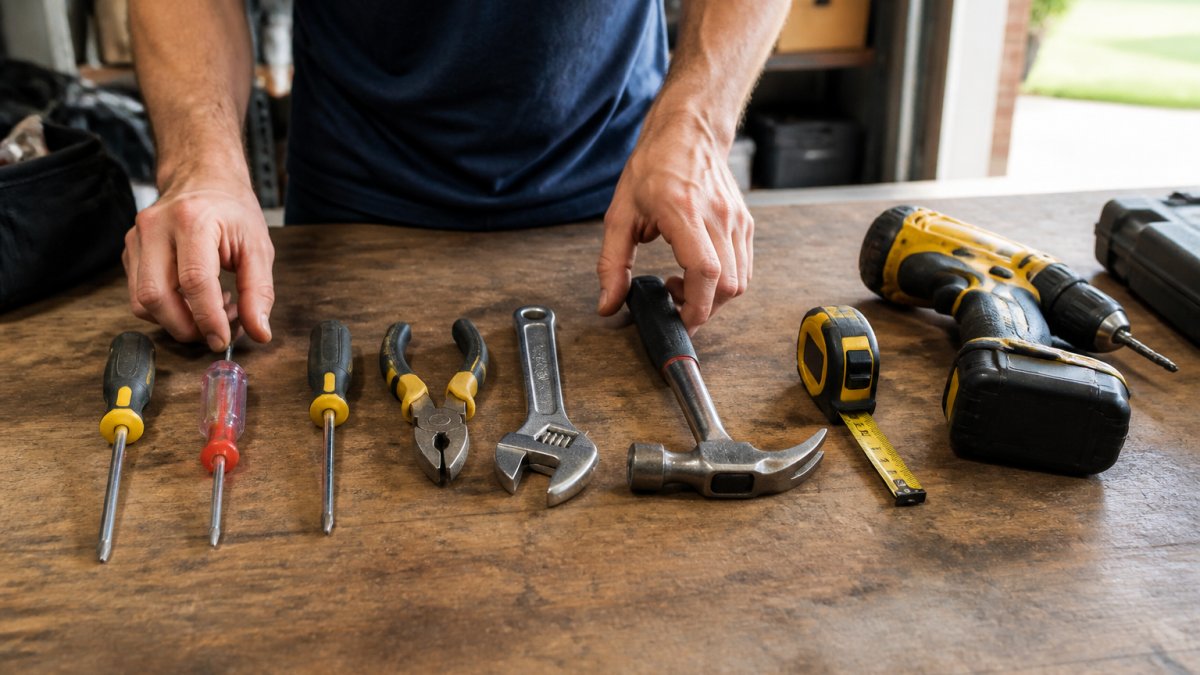
A common tools list for beginners covers screwdrivers, pliers, an adjustable wrench, a claw hammer, a tape measure, a level, a utility knife, and a cordless drill. That’s the core. Everything else is a specialist addition you make when a project demands it.
A workbench laid out with a beginner’s tool set including screwdrivers, pliers, an adjustable wrench, a claw hammer, a tape measure, and a cordless drill, with a person’s hands arranging them in a bright garage
Hand Tools: Screwdrivers, Pliers, Wrenches, and Hammers
Hand tools do the work that doesn’t need a motor. Start with a screwdriver set that covers Phillips, flathead, and a few square-drive sizes, because stripped screws usually come from using the wrong tip. Add locking pliers and needle-nose pliers for gripping and reaching. One adjustable wrench handles most nuts around the house.
A multitool earns its keep here too. The Leatherman Wave Alpha, featured in Bob Vila’s roundup of new hand tools, is the kind of single item that replaces a drawer of odds and ends for quick fixes.
Power Tools: Drills, Drivers, and Cutting Tools
A cordless drill-driver is the one power tool no home should be without. It drives screws, bores holes, and with the right bits, handles light material work. Add a circular saw if you cut lumber, and a jigsaw for curves and cutouts.
If you’re building a starter kit on a budget, our guide to the best budget tools for DIY projects walks through where to save and where to spend.
Essential Tools for Home Projects by Task and Material
Matching tools to the job beats buying by brand name. The material decides the bit, the blade, and the tool. Drywall wants a different approach than hardwood, and concrete wants a different drill entirely.
Here’s how we’d map it, with the reasoning behind each row:
Task
Material
Core Tools
Why These Tools
Skill Level
Hanging shelves and frames
Drywall, wood
Drill-driver, level, stud finder, tape measure
Drywall crumbles under load, so the stud finder locates framing; the level keeps the shelf true
Beginner
Assembling flat-pack furniture
Engineered wood
Screwdriver set, hex keys, rubber mallet
Engineered wood strips easily, so hand drivers give more control than a drill clutch
Beginner
Cutting trim and lumber
Softwood, MDF
Circular saw, jigsaw, clamps, square
A circular saw makes straight crosscuts; a jigsaw handles curves and cutouts a circular saw can’t
Intermediate
Basic auto maintenance
Metal fasteners
Socket set, ratchet, wrenches, pliers
Sockets grip hex fasteners on all six sides and resist rounding better than an open-end wrench
Beginner to intermediate
Sanding and finishing
Wood
Random orbital sander, sandpaper, dust mask
The orbital motion avoids the swirl marks a palm sander can leave; the mask matters because fine dust stays airborne
Beginner
Drilling into masonry
Brick, concrete, block
Hammer drill, masonry bits, safety glasses
Standard drill bits dull immediately on masonry; a hammer drill adds the pulsing action that breaks the surface
Intermediate
Notice the pattern: the same few tools recur. That’s the point of a focused kit.
A few material rules worth memorizing:
Softwood and MDF cut cleanly with standard wood blades, but MDF throws fine dust, so a dust mask and eye protection are not optional.
Hardwood dulls blades faster; a sharp carbide-tipped blade lasts longer and cuts cooler than a steel blade.
Metal needs a slower speed and a cutting fluid on drilled holes; running a bit fast work-hardens the metal and burns the tip.
Drywall wants a fine-tooth blade and light pressure; a coarse blade tears the paper face and ruins the finish.
Skill level matters as much as material. A beginner can hang a shelf with a drill-driver, a level, and a stud finder, but cutting trim with a circular saw takes practice before the cuts come out square.
Tools for Home Repairs: What to Keep Within Reach
Tools for home repairs should live in one accessible spot, not scattered across the garage. The repair kit is separate from the project kit. It’s the grab-and-go box for the leaky faucet, the loose hinge, and the wobbly chair.
Adjustable wrench and pliers for plumbing fittings
Screwdriver set with multiple tips
Utility knife and a roll of tape
Flashlight and a small level
Hex key set for furniture and fixtures
The mistake we see most often is storing the repair kit behind the project tools. When a pipe drips at night, you want one box, one location, zero searching. A wall-mounted organizer or a single toolbox solves this for good.
How to Choose Tools: Manual Versus Powered, and What to Skip
Manual tools win on control, cost, and quiet. Powered tools win on speed and repetition. The decision comes down to how often you’ll do the job, how much force it needs, and how much precision the result demands.
Manual Versus Powered: The Real Trade-Offs
Factor
Manual Tools
Powered Tools
Control
High, you feel the fastener seat and stop before you strip it
Lower, a clutch helps, but torque can still overdrive
Speed
Slow for repetition
Fast, dozens of fasteners in the time a hand driver does a few
Cost
Low entry price, no battery platform
Higher entry price, plus batteries and chargers
Portability
No cord, no battery, works anywhere
Needs power or a charged battery
Maintenance
Wipe and oil; lasts decades
Brushes, batteries, and cords wear out
Noise and dust
Quiet, low dust
Loud, throws dust and chips
Choose manual when the task is occasional, delicate, or tight on space. A screwdriver beats a drill for a soft-wood cabinet hinge you don’t want to strip, and a hand saw beats a circular saw for a single cut in a finished room where dust and noise matter.
A useful rule: if you’ll do the job more than a handful of times a year, the powered version pays for itself in time. If it’s a one-off, borrow or rent first.
Buying Considerations Beyond Brand
Brand is the least useful filter for a beginner. These criteria matter more:
Durability, look for forged steel in wrenches and sockets, hardened tips on screwdrivers, and carbide teeth on saw blades. Soft metal tips round off and strip fasteners.
Ergonomics, a tool you grip for an hour should fit your hand. Cushioned handles and a balanced weight reduce fatigue more than a brand name does.
Compatibility, if you buy cordless, stay within one battery platform so batteries and chargers interchange. Mixing platforms multiplies cost.
Warranty, a lifetime warranty on hand tools is common; power tool warranties vary, so read the terms before you buy.
Total cost, the sticker price is only part of it. Batteries, bits, blades, and replacements add up, and a cheap tool that fails early costs more than a better one that lasts.
What to Skip
Single-purpose gadgets, bargain-bin multi-bit sets with soft metal tips, and any tool you can’t name a use for. A common mistake is buying a full brand-matched kit before you know your projects. Buy the core first, then add specialists as jobs appear. If you’re weighing cheaper refurbished options, our guide on whether refurbished tools are reliable for DIY explains what to check.
Safety, Maintenance, and Making Tools Last
Safety gear is not optional, and it’s cheap relative to a hospital visit. Eye protection, hearing protection for power tools, gloves for sharp edges, and a dust mask for sanding cover most home work. The OSHA guidance on hand and power tools is a useful reference for safe handling basics.
Maintenance extends tool life more than any brand choice:
Wipe metal tools dry after use and add a light oil film to prevent rust
Keep drill bits and blades sharp; a dull blade is more dangerous than a sharp one
Store batteries at moderate temperature and charge them as the maker directs
Check cords and housings for damage before each use
Watch out: skipping the condition description and buying on price alone is the fastest way to end up with a tool that doesn’t fit your project. The listing tells you what you’re getting.
Frequently Asked Questions
What are the 10 common tools a beginner should own?
A practical starter set covers a tape measure, claw hammer, screwdriver set, adjustable wrench, pliers, utility knife, level, cordless drill, hex key set, and safety glasses. These handle most assembly, hanging, and tightening jobs around a home. Add a stud finder and a small socket and ratchet set once you take on furniture or fixture work. You do not need every category on day one; buy the tools that match the projects you actually have planned, then expand as new jobs come up.
What is the difference between hand tools and power tools?
Hand tools rely on your own force, so they are quieter, lighter, and need no battery or outlet. Power tools use a motor to do the work faster, which matters for drilling, driving long screws, or cutting. For a single shelf, a screwdriver and drill are enough. For repeated assembly or larger builds, a cordless drill and driver saves real time. Many beginners start with hand tools and add one cordless tool once the project list grows.
How do I choose tools for home repairs without overspending?
Match the tool to the job and the material first, then decide between manual and powered versions. A basic kit of screwdrivers, pliers, a wrench, a hammer, and a tape measure covers most repairs. Buy the specialty tool only when a specific repair calls for it. Check condition and included accessories before buying, since a complete set with the right bits and cases often costs less than assembling pieces one at a time.
Are open-box tools a safe way to build a starter set?
Open-box tools can stretch a budget if you check the listing carefully. Look at the photos for wear on grips, chipped bits, missing batteries, or a damaged case, and read the full condition description for what is included. Confirm the model and voltage match what you need. A tested open-box drill with its charger and battery can cover the same beginner projects as a new one, provided the listing is clear about its condition.
The challenge is not finding tools. It’s building a set that matches how you actually work, then buying it without overpaying. The Wise Buy stocks tested, inspected open-box and overstock tools from trusted brand names, with detailed photos and full condition descriptions on every posting so you can decide with confidence. Create an account with The Wise Buy and start building a kit that earns its place in your garage.

 Add more eligible items to your cart to unlock free shipping.