Best Budget Tools for DIY Projects: What to Buy First
The best budget tools for DIY projects are the ones that match the job in front of you, not the biggest kit on the shelf. This guide from The Wise Buy covers what to buy first, what to borrow, and how to keep total costs down. A starter kit of hand tools plus one cordless drill handles most homeowner repairs. We’ll show you exactly which tools earn their place.
Budget tools are affordable hand and power tools that deliver reliable performance for light-duty tasks without the price of professional-grade equipment. The goal is value, not the lowest sticker price.
Key Takeaway Buy for the projects you actually have planned. A focused starter kit beats a giant set full of tools you’ll never touch.
How to Match Tools to the Project
Start with the project, then buy the tool. Beginners often do this backwards: they buy a kit first and hunt for something to use it on.
Here’s the practical way to match them:
Project
Core Tools Needed
Hanging shelves or art
Drill/driver, level, measuring tape, stud finder
Assembling furniture
Screwdriver set, hex keys, adjustable wrench
Small repairs
Hammer, pliers, utility knife
Sanding and refinishing
Orbital sander, sandpaper, scraper
Cutting lumber
Circular saw or hand saw, clamps
Write down your next three projects. The tools that appear on every list are the ones to buy now.
Best Tools for DIY Beginners: A Simple Starter List
The best tools for DIY beginners are a cordless drill, a screwdriver set, a measuring tape, a level, a hammer, pliers, and an adjustable wrench. That short list covers assembly, hanging, tightening, and light repairs.
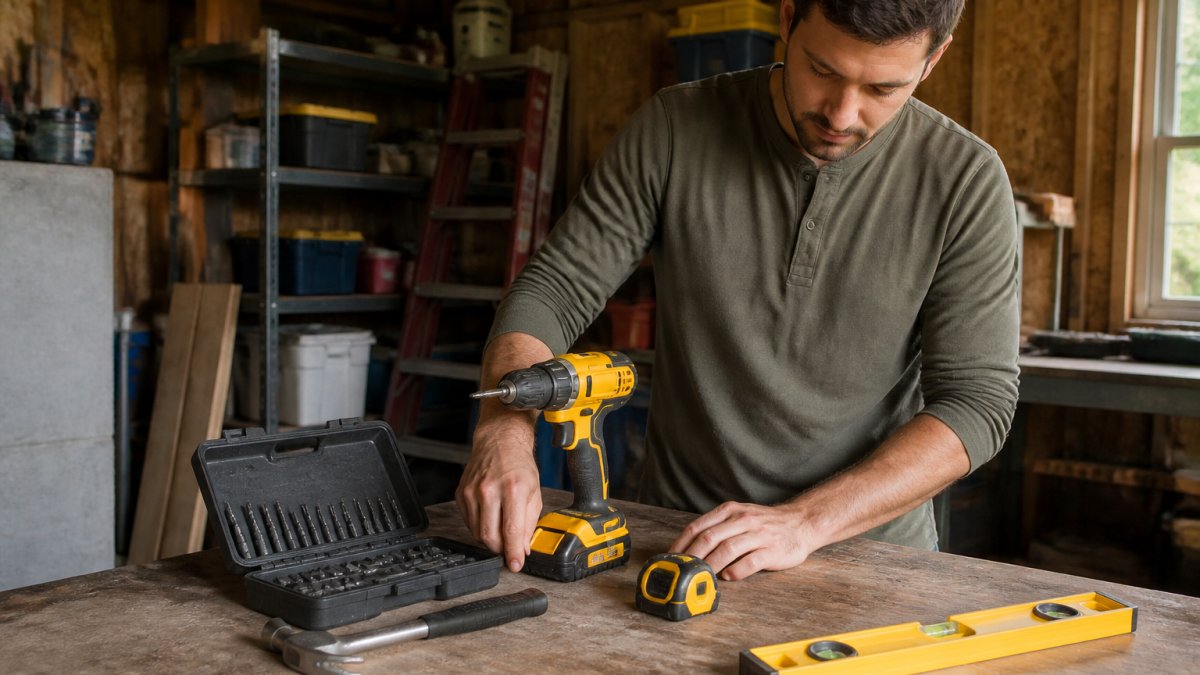
A homeowner in a garage workshop organizing a starter tool kit with a cordless drill, screwdriver set, measuring tape, hammer, and level laid out on a workbench
Hand Tools Worth Owning First
Hand tools are cheap, durable, and never need a battery. Buy these before you spend on power tools.
Screwdriver set with assorted bits, including Phillips and flathead
Claw hammer for nails and light demolition
Adjustable wrench that fits multiple nut sizes
Pliers: a combination pair and a needle-nose pair
Measuring tape at least 25 feet long
Spirit level for anything that needs to sit straight
Utility knife for cutting and scraping
A common mistake is buying the cheapest set available. Stripped screw heads and rounded nuts cost more time than the few dollars you save.
Cordless Drill and Driver Basics
A cordless drill is the one power tool every beginner should own. Look for a drill/driver with a brushless motor if the budget allows; brushless motors run cooler and last longer. A smooth start feature helps on delicate work. Most starter kits include a battery and charger, which matters for total cost.
Affordable Power Tools for Home Use: Corded, Cordless, or Manual
Affordable power tools for home use come in three forms, and the right choice depends on where you’ll work. Cordless tools win for portability. Corded tools give constant power for longer jobs. Manual tools cost the least and never run out of charge.
Choose based on your situation:
Cordless: best for quick jobs around the house and anywhere without an outlet
Corded: best for sanding, cutting, and tasks that run for an hour or more
Manual: best for one-off projects and tight budgets
Pro Tip If you only use a tool once or twice a year, a corded version often costs less upfront and never needs a replacement battery.
Saws, Sanders, and Cutting Tools
Cutting and sanding tools are where budgets stretch fastest. A circular saw handles straight cuts in lumber. A jigsaw cuts curves and shapes. An orbital sander smooths surfaces before painting. A hand saw covers small jobs without any power at all.
For a first purchase, a jigsaw is more forgiving than a circular saw for beginners. Add an orbital sander only when you have a refinishing project planned.
DIY Tool Buying Tips: Total Cost of Ownership and Durability
DIY tool buying tips usually focus on the sticker price. The smarter approach is total cost of ownership: the tool, the batteries, the charger, the bits, the blades, and the replacements over time. A tool that costs less on the shelf can cost more by the end of its second year.
The Battery Platform Is the Real Purchase
When you buy a cordless tool, you’re also buying into a battery platform. That decision outlasts the tool itself.
Proprietary batteries only fit one brand’s tools. If the brand discontinues the pack, every tool on that platform becomes a paperweight.
Shared platforms let one battery and one charger run a drill, an impact driver, a sander, a trim saw, and a light. The second tool on the platform is effectively cheaper because you already own the power source.
Off-brand replacement packs are cheaper per unit but commonly deliver less sustained power and shorter cycle life. A pack that sags under load turns a capable drill into a frustrating one.
A common pattern is a buyer who saves on the first drill, then discovers the second tool on that platform costs more than a competitor’s equivalent because the battery ecosystem is thin. Before you commit, look at how many tools the brand actually sells on that battery, that number tells you how long the platform will be supported.
Consumables: The Cost That Never Stops
Every cutting, sanding, and drilling tool has a consumable attached to it. These are not one-time purchases.
Sanding: sheets and discs wear out in minutes on painted or finished surfaces. Budget for several per project.
Saw blades: a dull blade burns wood and wanders off the line. A cheap blade on a good saw produces worse cuts than a good blade on a cheap saw.
Drill bits: brad-point and masonry bits dull quickly in hardwood and concrete. Buying a small set of quality bits beats replacing a bargain assortment repeatedly.
Screwdriver bits: the bit wears before the driver does. A pack of replacement bits is one of the highest-value purchases in a starter kit.
Durability: What Actually Lasts
Durability in budget tools comes down to a handful of components you can inspect before buying:
Chuck: a metal keyless chuck grips better and lasts longer than a plastic-bodied one.
Gears: metal gear trains survive stalls and overloads that strip plastic gears.
Motor: brushless motors run cooler and last longer than brushed motors, and they don’t have replaceable brushes to wear down.
Housing and switches: a rubberized overmold and a sealed trigger resist dust, which is what kills most budget power tools.
Warranty and Repairability: Read the Fine Print
Before buying, check three things:
What the warranty actually covers. Many tool warranties exclude the battery and charger, which are the parts most likely to fail first.
Whether replacement batteries are easy to find. A discontinued pack turns a working tool into scrap.
Whether the brand sells spare parts. Switches, brushes, chucks, and cords are commonly replaceable. A new switch is far cheaper than a whole new tool, but only if the part exists.
If a brand won’t sell you a replacement switch or a new battery, treat the tool as disposable and price it accordingly.
Pro Tip When comparing two tools, add the cost of one spare battery, one set of consumables, and one likely replacement part to each. The cheaper sticker often loses that comparison.
Basic Tool Kit for Homeowners: Measuring, Fastening, and Safety Gear
A basic tool kit for homeowners should cover measuring, fastening, and safety. Measuring tools keep projects square and level. Fastening tools hold everything together. Safety gear keeps you out of the emergency room.
Safety equipment is the most-skipped category and the one that matters most:
Safety glasses for any cutting, drilling, or sanding
Work gloves for handling lumber and sharp edges
Ear protection for power saws and sanders
Dust mask for sanding and painting
Watch Out Skipping eye protection during cutting or drilling is the fastest way to a serious injury. Safety glasses cost little and prevent the injuries that send beginners to urgent care.
When to Borrow, Rent, or Buy: Smart Tool Selection
Smart tool selection means buying what you’ll use often and borrowing or renting the rest. A tool you’ll use once a year rarely justifies the cost of ownership.
Use this rule of thumb:
Buy: tools you’ll use more than a few times a year
Borrow: one-off tools a neighbor or family member already owns
Rent: expensive tools for a single large project, like a tile saw or floor sander
Renting also lets you try a tool before committing to a purchase. If you rent the same tool twice, that’s your signal to buy.
Where to Find Budget Tools Online
Online shopping is where budget-conscious buyers find the best value, especially on open-box and overstock items. These are brand-name tools sold at a fraction of retail because the packaging was opened or the item was overstocked.
At The Wise Buy, every item is tested and inspected before it’s listed. We provide detailed product descriptions and photos so you can see the exact condition, and our inventory includes trusted brand names across tools, home goods, and electronics. Because we’re online only, the full condition and description of every item is on our posting, so you always know what you’re getting before you buy.
Best For Budget-conscious homeowners and renters who want brand-name tools and home goods without paying full retail.
Conclusion: Build Your Kit One Project at a Time
Building a tool kit is a process, not a single purchase. Start with hand tools and a cordless drill, then add power tools as projects demand them. Buy for frequency, borrow or rent for one-offs, and always factor in batteries and accessories when comparing cost.
When you’re ready to add to your kit, The Wise Buy offers tested, inspected open-box and overstock tools at a fraction of retail. Browse our listings to see full condition details and photos, then create an account to start saving on the tools your next project needs.
Frequently Asked Questions
What basic tools should a beginner have at home?
Start with a cordless drill/driver, a screwdriver set with common bits, a 25-foot measuring tape, a level, a hammer, slip-joint pliers, an adjustable wrench, a utility knife, and a hand saw. These cover assembly, hanging, tightening, and light cutting. Add safety glasses and work gloves before your first project. A small starter tool kit with these basics is enough for most apartment and homeowner tasks, and you can add specialty tools as projects come up.
Are budget power tools good enough for home projects?
For light-duty tasks like hanging shelves, assembling furniture, and small repairs, budget power tools work well. Look for a brushless motor when you can, a smooth start feature, and a battery platform you can expand. The main trade-off is durability and run time compared to pro-grade tools, but for occasional weekend use that gap rarely matters. Check the tool’s warranty and whether replacement batteries and parts are easy to find before buying.
Where can you find affordable tools for DIY projects?
Online retailers that sell open-box and overstock inventory often carry brand-name tools at lower prices than retail. The Wise Buy lists detailed photos and full condition descriptions on each posting, so you can review the exact item before buying. Compare total cost, including batteries, chargers, and accessories, not just the sticker price. Reading the condition notes and asking questions before checkout helps you avoid surprises.
Which DIY tools should you buy first?
Buy tools in the order your projects demand them. Most people start with a cordless drill/driver, a screwdriver set, a measuring tape, and a level. If you plan to cut wood, add a circular saw or jigsaw. If you sand or refinish furniture, add an orbital sander. Borrow or rent one-off tools like a heat gun or oscillating tool until you use them often enough to justify buying your own.

 Add more eligible items to your cart to unlock free shipping.