Best Food Processor: Tested Picks for Every Kitchen
Homepage Best Food Processor: Tested Picks for Every Kitchen
Last Updated: November 8, 2026
Quick Summary
The Breville Sous Chef is our top overall food processor pick for home cooks who want one versatile machine for everyday prep. For families or batch cooking, a 13- to 14-cup bowl is the practical ceiling for most home kitchens, while smaller households do well with a 7- to 9-cup model.
Match bowl capacity to household size, from 7-9 cups for 1-2 people to 13-14 cups for 4 or more.
Full-size food processors commonly fall in the 500- to 1,000-watt range, and continuous-run ratings matter more than peak wattage.
Use pulse bursts and stop as soon as dough forms a ball to avoid overworking the gluten.
Choose a food processor for chopping, shredding and dough, and a blender for smooth liquids like smoothies and soups.
Confirm the exact model’s included attachments and dishwasher rules before you buy.
Need a food processor that fits your budget?The Wise Buy lists tested open-box and overstock kitchen appliances from trusted brands.
Choosing a food processor starts with a clear picture of what you cook. A household that makes weekly batches of dough needs a different machine than one that mostly chops onions and grates cheese. We built this list around that idea, looking at bowl capacity, motor strength, attachments, and how easy each model is to assemble and clean.
Our selection draws on editorial buying guides and specialist reviews, which repeatedly point to a few recurring criteria: chopping and dicing performance, slicing and shredding results, and value for the money. Every pick below reflects those criteria, and we note where the available information is limited.
Some models in this list come with less detail than others. Where we could not confirm a current price or a specific feature, we say so, and we recommend checking the manufacturer’s listing or the product page on our site for the latest details.
Best Overall Food Processor: Breville Sous Chef
The Breville Sous Chef earns our top overall pick because it performed strongly in the editorial testing we reviewed. For a home cook who wants one machine that handles varied prep work, this is a solid starting point.
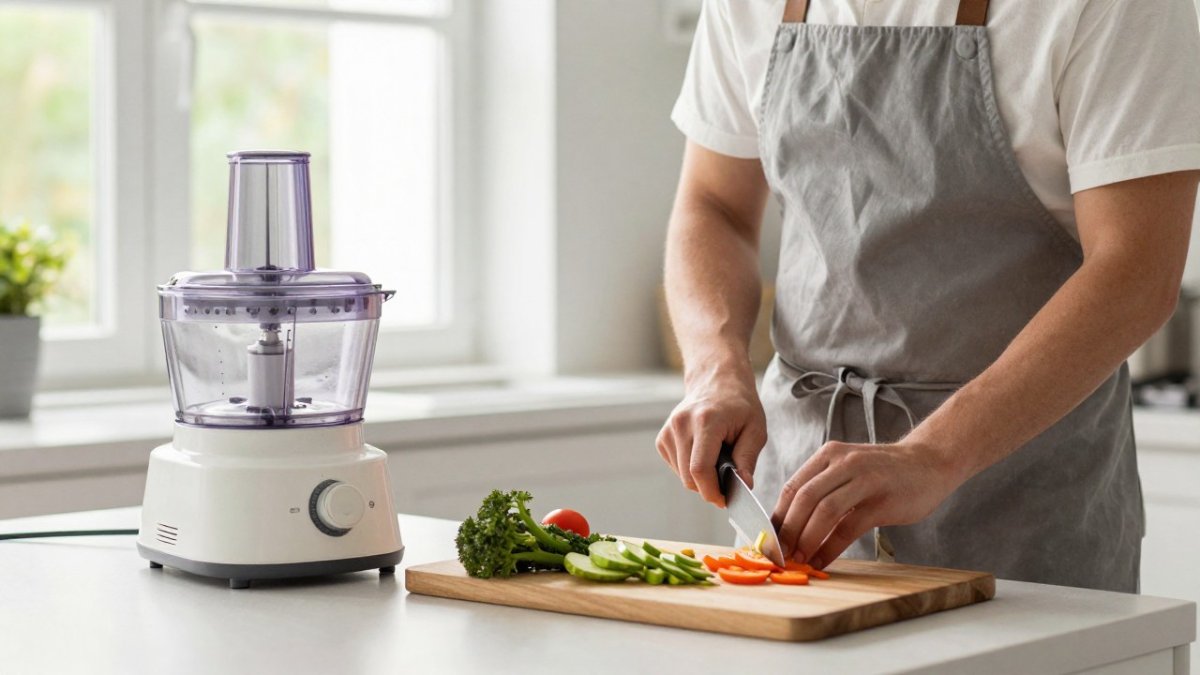
Home cook slicing fresh vegetables on a counter next to a powerful food processor
A related 16-cup Sous Chef model is described by Food & Wine as offering generous capacity and numerous attachments. That makes the larger version a good match for families or anyone who batches meals. The main limitation is that the sources we reviewed did not give a verified current price or full specifications for each Sous Chef model, so compare the exact version you are considering before you buy.
Best for: home cooks who want a versatile, full-size processor for everyday prep.
Best Large-Capacity Food Processors: Cuisinart and KitchenAid Models
If you regularly cook for a crowd, capacity matters more than extras. The Cuisinart Custom 14-Cup Food Processor is a model with a 14-cup bowl for larger batches. Its 14-cup bowl handles larger batches without repeated loading, and it suits anyone who values a straightforward machine over a long feature list.
The Cuisinart Core Custom 13-Cup Food Processor is another option with a 13-cup bowl. KitchenAid’s 13-cup model (KFP1318) is another capable choice for larger prep jobs, though the sources we reviewed did not verify its attachments or motor power.
Across these models, the tradeoff is usually between simplicity and added features. Pick the simpler machine if you mainly chop and shred, and the feature-rich one if you want more built-in options.
Best for: families and frequent batch cooks who need a large work bowl.
Best Compact and Multi-Function Picks
Not every kitchen has room for a full-size processor. Compact models suit small counters, apartment kitchens, and anyone who preps small quantities. The Haier I-Master Series 5 Compact Food Processor is a compact model, so check the spec sheet for its exact capacity before buying.
Multi-function appliances are another option. Our guide also explains what to check when considering a refurbished compact model. The Ninja 3-in-1 Food Processor combines food processing with blending, which can reduce the number of appliances you store.
A few compact and multi-function models shown in our research did not include verified pricing, so treat their details as a starting point rather than a final spec.
Best for: renters, small kitchens, and cooks who want fewer appliances.
Food Processor Buying Guide: Size, Power and Attachments
Bowl capacity by household and habit. Capacity is usually quoted in cups, and the working range runs from about 3 cups on mini choppers to 14 cups and beyond on full-size machines. A common pattern is:
1-2 people, light prep: a 7- to 9-cup bowl covers onions, garlic, herbs, single-batch pesto, and a couple of cups of shredded cheese. It stores more easily and handles small quantities without the food scattering below the blade.
3-4 people, regular cooking: a 11- to 12-cup bowl is the middle ground. It handles a full head of cabbage for slaw, a pound of cheese, and single loaves of dough.
4+ people or batch cooking: a 13- to 14-cup bowl is the practical ceiling for most home kitchens. It mixes double batches of pizza dough and processes large volumes without reloading.
Bigger is not automatically better.
Motor power and what it actually buys you. Wattage is the headline number, and full-size processors commonly fall in the 500- to 1,000-watt range, with compact models lower. Wattage alone does not predict performance, blade design, bowl shape, and gearing matter, but a few practical thresholds hold up:
Dense tasks like kneading bread dough, grinding nuts into butter, and chopping frozen or hard ingredients benefit from a stronger motor and a heavier base that will not walk across the counter.
Light chopping and shredding are handled fine by mid-range motors.
Continuous-run ratings matter more than peak wattage. A motor rated for longer continuous use tolerates big batches without overheating; a short-duty motor may need cool-down breaks between loads.
Attachments and what ships in the box. Standard kits usually include an S-shaped metal chopping blade, a reversible slicing/shredding disc, and a plastic dough blade. Beyond that, check the listing carefully, because these are frequently sold separately or only on higher trims:
Adjustable or multi-width slicing discs
Julienne and french-fry discs
Citrus juicer or whisk attachments
A second, smaller work bowl nested inside the main bowl
A dough blade is worth having if you bake; it is gentler on gluten development than the metal S-blade.
Feed tube size. The feed tube determines how much pre-cutting you do. Wide-mouth tubes (roughly 3 inches across on many full-size models) accept a whole potato, a block of cheese, or a whole cucumber.
Controls and ease of use. Look for a pulse function plus at least two continuous speeds. Pulse gives you control over texture, coarse versus fine chop, and continuous run suits dough and purees. Large, clearly labeled buttons are easier to use with wet or floury hands.
Watch out: a feed tube that looks wide can still require pre-cutting larger vegetables, and a disc that is listed as included may ship only with a specific model number, confirm the exact SKU’s contents before you buy.
The table below summarises the main bowl-size guidance from the buying guide, matched to household size and typical use.
Household
Bowl capacity
Typical use
1-2 people, light prep
7-9 cups
Onions, garlic, herbs, single-batch pesto
3-4 people, regular cooking
11-12 cups
Full head of cabbage, a pound of cheese, single dough loaves
4+ people or batch cooking
13-14 cups
Double batches of pizza dough, large volumes
Bowl capacity
1-2 people, light prep 7-9 cups
3-4 people, regular cooking 11-12 cups
4+ people or batch cooking 13-14 cups
Food Processor vs Blender: Which One Do You Need?
A food processor and a blender do overlapping jobs, but they are built for different tasks. A food processor is best for chopping, slicing, shredding, grating, and mixing dough. Its wide bowl and interchangeable discs handle solid ingredients well. A blender excels at smooth liquids such as smoothies, soups, and sauces, where a tall, narrow jar pulls ingredients into the blade.
If you mostly make soups, shakes, or drinks, a blender will serve you better. If you chop vegetables, shred cheese, or knead dough, a food processor is the better tool. Many households end up with both, but a multi-function unit can cover much of the overlap if you do not need peak performance in either role.
The right choice depends on your cooking habits. Think about the three or four tasks you do most, and buy the machine built for them.
Using a Food Processor for Dough and How to Clean It After
A food processor can mix pie crust, pizza dough, and sandwich bread dough faster than by hand, but it punishes overprocessing. The machine develops gluten quickly, so the margin between “just combined” and “tough” is narrow.
Dough technique that works. Use the plastic dough blade when one is included; otherwise the metal S-blade works but cuts the dough more aggressively.
Respect the capacity limit. Dough rises and stresses the motor, so most manufacturers cap dough volume well below the bowl’s liquid capacity, often around 2 to 3 cups of flour for a full-size machine, less for compact models. Check your manual’s dough rating. Overloading strains the motor and can cause the machine to stall or overheat.
Safety and blade handling. Modern processors will not start unless the bowl is locked onto the base and the lid is locked onto the bowl; forcing a misaligned lid can crack the plastic, so seat it fully before pressing start.
Cleaning without the hassle. Rinse the bowl and blade immediately after use, before dough dries, dried dough bonds to plastic and takes far longer to remove.
Watch out: running the processor with the lid unlocked or the bowl misaligned will not start the motor, but forcing the lid can crack the bowl, and reaching in to clear jammed dough before unplugging is the most common cause of serious cuts.
Find Your Food Processor Deal at The Wise Buy
At The Wise Buy, we carry a wide selection of kitchen appliances, including open-box and overstock food processors from trusted brand names. Every item is tested and inspected before it is listed, and each product page includes detailed descriptions and photos so you can see the condition before you order.
Pricing on our food processors depends on the model, its condition, and current stock, so please check the product page on our site for the current price and listing details. Our guide also explains whether an open-box item comes with any warranty before you buy. If you are comparing a specific model from this guide, search for it on our site to see what is available.
Ready to find a food processor that fits your kitchen? Create an account to save your favorites and track new arrivals.
Frequently Asked Questions
What is the best food processor for home use?
For most home cooks, a full-size model with a work bowl of roughly 11 to 14 cups covers chopping, shredding, slicing and pureeing without much fuss. The Breville Sous Chef performed strongly in the editorial testing we reviewed, and it suits people who cook several times a week. If you mostly prep small batches, a compact model may be a better fit. Check the current listing on The Wise Buy for availability, condition and pricing before you decide.
What size food processor should I buy?
Match the bowl capacity to how much you cook at once. A 7 to 9 cup model works for one or two people and small tasks like making dips or pesto. For families, meal prep or frequent baking, a 13 to 14 cup bowl gives you room for larger batches. Feed tube width also matters, since a wider tube means less pre-cutting of vegetables.
Can a food processor knead dough?
Yes, most food processors can mix and knead small to medium batches of dough, particularly bread and pizza dough, provided the model includes a dough blade. Work in short pulses and avoid running the motor continuously, since heavy dough can strain the motor. For large or very stiff doughs, a stand mixer is the more reliable tool. Always review the attachments included with the specific model you are considering.
Is a food processor worth it for everyday cooking?
A food processor is worth it if you regularly chop vegetables, shred cheese, make sauces or prepare dough. It saves time on repetitive prep and produces more consistent results than hand chopping for many tasks. If you rarely cook from scratch or only need to chop a small amount of food now and then, a good knife and a small chopper may be enough. Decide based on how often you would use the attachments.

 Add more eligible items to your cart to unlock free shipping.