The Best Bluetooth Car Adapters for Hands-Free Calling
Homepage The Best Bluetooth Car Adapters for Hands-Free Calling
Understanding the Types of Bluetooth Car Adapter Options
A Bluetooth car adapter is the simplest and most affordable way to add wireless audio and hands-free calling to any car that didn’t come with it built in. No stereo replacement needed.
Here are the best Bluetooth car adapters at a glance:
Adapter
Type
Best For
Price Range
Nulaxy KM18
FM Transmitter
Easy plug-and-play use
~$20
ZEEPORTE FM50
FM Transmitter
Fast charging + audio
~$20–$25
UGREEN Bluetooth 5.4
Aux Receiver
Static-free audio, 15hr battery
~$12–$15
Anker Soundsync A3352
Aux Receiver
Compact, 12hr battery
~$20–$25
GROM-BT3
Factory-Integration Kit
OEM look, steering wheel controls
~$179.99
There are three main types to know about:
FM transmitters — plug into your 12V socket and broadcast audio over an FM station
Aux Bluetooth receivers — plug into your car’s 3.5mm jack for direct, static-free sound
Factory-integration kits — wire behind the dash for a seamless, built-in look
If your car has a 3.5mm aux jack, go with an aux receiver. It sounds better and costs less. If it doesn’t, an FM transmitter is your next best option.
Older cars are the most common use case here. Millions of vehicles on the road today still have a fully working stereo — just no Bluetooth. A good adapter fixes that for under $20 in most cases.
I’m Ally Wise, Sales Manager at TheWisebuy.net, and I’ve spent years helping customers find the right tech accessories — including the right Bluetooth car adapter — without overpaying or getting stuck with something that doesn’t fit their setup. In this guide, I’ll walk you through every major adapter type, what to look for, and which ones are worth your money in 2026.
Before you purchase any adapter, you need to understand how each type works and which one matches your car’s existing dashboard layout. The best adapter is the one you forget is even there, working seamlessly in the background every time you turn the key.
The layout of your car’s stereo determines your choice. If you have a 3.5mm auxiliary input, your path is clear: an auxiliary receiver will yield the cleanest audio. If you only have a 12V cigarette lighter socket and an FM radio, an FM transmitter is your low-tech savior. For those who want a completely invisible installation that preserves steering wheel controls, factory-integration kits are the ultimate premium choice.
The FM Transmitter: The Easiest Bluetooth Car Adapter for Older Vehicles
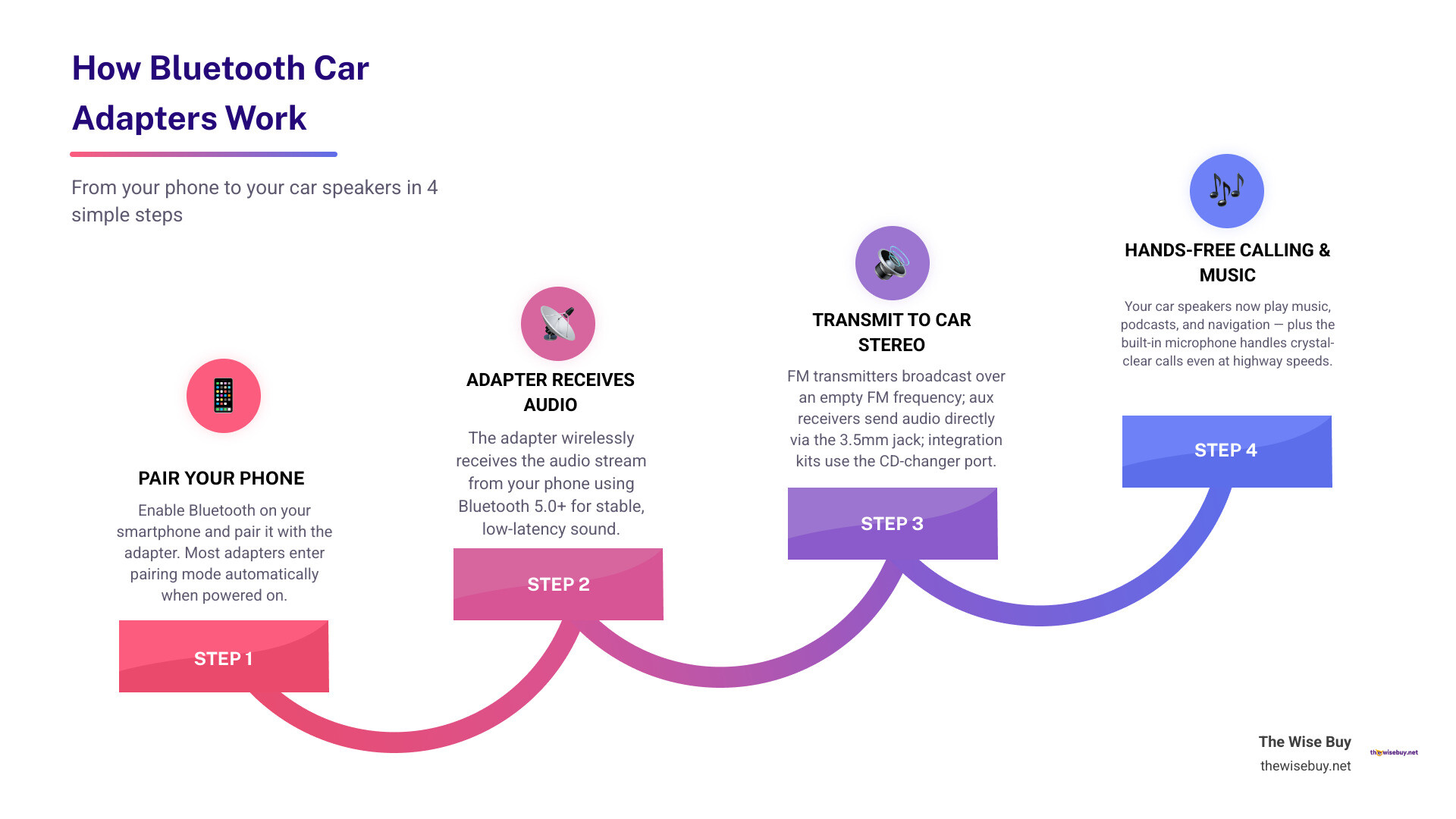
If your car lacks a 3.5mm auxiliary port and only has a standard radio, an FM transmitter is the easiest way to bridge the gap. These plug-and-play transmitters insert directly into your car’s 12V power socket (the old cigarette lighter). Once powered, they establish a wireless Bluetooth connection with your smartphone and then broadcast that audio signal over an empty FM radio frequency. You simply tune your car stereo to the exact same frequency, and your music plays through your car speakers.
While it sounds slightly redundant to convert a digital Bluetooth stream into analog FM radio waves, this workaround is incredibly effective for older vehicles.
Many modern models are multi-port powerhouses. For example, the Lencent FM Transmitter, priced at a budget-friendly $14.24 on Amazon, includes a microSD card slot and a dedicated voice assistant button. The ZEEPORTE FM50 FM transmitter steps up the utility by offering USB-C Power Delivery up to 27W for fast charging.
However, FM transmitters do have a physical audio quality ceiling due to the limitations of FM radio broadcasts. In crowded city centers, you may occasionally experience static interference if a local radio station begins broadcasting near your selected frequency.
The Auxiliary Bluetooth Car Adapter: Direct, Static-Free Audio
If your car has a 3.5mm auxiliary input, you should bypass FM transmitters entirely and opt for a high-fidelity auxiliary Bluetooth receiver. These small dongles plug directly into your car’s aux jack, transferring the audio signal via a physical wire rather than over the airwaves. This results in a direct, static-free connection with significantly better bass response and overall clarity.
There are two main styles of aux adapters:
Rechargeable Portable Receivers: These contain built-in batteries and do not need to be constantly plugged into a power source, keeping your dashboard clutter-free. The Anker Soundsync A3352, for example, features a 12-hour battery life and weighs only 50 grams, making it incredibly lightweight and portable. The UGREEN Bluetooth 5.4 Car Adapter is another stellar choice, offering approximately 15 hours of battery life per charge and utilizing the latest Bluetooth 5.4 standard for rapid auto-reconnection.
USB-Powered Aux Dongles: These draw power continuously from a nearby USB port or 12V adapter. The UGREEN 5.4 Aux Bluetooth Adapter is a highly reliable plug-and-play dongle available for just $12.62 on Amazon.
One common issue with auxiliary adapters is ground loop noise—a low, high-pitched hum or buzz that occurs when the adapter is charging from the car’s 12V system while playing music through the aux port. While some premium kits include a ground loop noise isolator, many users find that simply using a high-quality, shielded aux cable resolves the issue completely.
Factory-Integration Kits: Seamless OEM Control
For drivers who want to keep their dashboard looking completely original while enjoying modern wireless features, factory-integration kits are the gold standard. These kits do not plug into your 12V outlet or your aux port. Instead, they require a behind-the-dash installation, wiring directly into the back of your factory stereo—typically utilizing the unused CD-changer port.
The primary benefit of an OEM-style integration kit is control. Because it connects directly to the car’s internal communication network, you can use your factory steering wheel audio controls to skip tracks, adjust volume, and answer phone calls.
A prime example is the GROM-BT3 factory-integration kit. Priced at approximately $179.99, it is a premium investment compared to a $15 dongle. However, for owners of classic luxury cars or older vehicles where replacing the head unit would ruin the clean aesthetic of the dashboard, the GROM-BT3 is worth every penny. It delivers flawless, high-fidelity audio directly into the factory amplifier without any visible wires or aftermarket screens.
Key Features to Look For in a Car Bluetooth Adapter
To help you decide which adapter category fits your driving habits, let’s look at how these options compare across key categories:
Feature
FM Transmitters
Aux Receivers
Factory-Integration Kits
Audio Quality
Moderate (FM ceiling, prone to static)
High (Direct physical wire)
Excellent (Direct digital input)
Installation
Instant (Plug into 12V socket)
Easy (Plug into 3.5mm jack)
Moderate to Hard (Behind-the-dash)
Steering Controls
No (Must use phone or adapter buttons)
No (Must use phone or adapter buttons)
Yes (Integrates with OEM buttons)
Extra Features
Fast charging ports, microSD slots
Compact size, battery power
Completely hidden, seamless look
Beyond the basic connection type, you should evaluate adapters based on hands-free call quality, device charging speeds, and smart assistant integration.
Hands-Free Calling and Microphone Quality
A major reason to buy a Bluetooth car adapter is to make and receive phone calls safely while driving. However, call clarity varies wildly between cheap models and high-end units.
Since your car’s cabin is filled with road noise, engine hums, and air conditioning drafts, a standard microphone won’t cut it. Look for adapters equipped with advanced audio processing technology, such as Qualcomm cVc Noise Cancellation or dual-microphone arrays. These systems actively filter out ambient cabin noise to isolate your voice.
For instance, the Amazon Echo Auto (2nd Gen), priced at $54.99, features a multi-microphone array designed specifically to hear your voice over loud road noise and music. It also integrates Alexa voice assistant capabilities, allowing you to control smart home devices, queue up playlists, or send hands-free messages.
When positioning your adapter, try to mount the microphone as close to your face as possible—ideally on the dashboard or near the steering column—and keep it away from direct blasts from your A/C vents.
Multi-Device Charging and Power Delivery
Your 12V socket is no longer just a power source for a cigarette lighter; it is a full-time charging hub. If you choose an FM transmitter that plugs into your 12V outlet, make sure it has robust power outputs so you don’t lose the ability to fast-charge your phone.
Modern adapters have evolved into highly capable multi-port chargers, often referred to as “4-in-1 car chargers” because they combine Bluetooth, FM transmission, hands-free calling, and high-speed charging.
Here is how some of the top multi-port chargers stack up in terms of wattage and output options:
JOYROOM 81W Bluetooth FM Car Adapter (JR A1): The ultimate power option for users who need to charge high-draw devices like laptops or tablets. It pairs a USB-C Power Delivery (PD) port offering up to 45W with a USB-A Quick Charge (QC) port at 36W, delivering a massive total output of 81W.
Nulaxy NX16 Bluetooth Car Adapter: A fantastic value choice for families or carpools, providing four charging outputs. It features a USB-C PD 36W port, a USB-A QC 18W port, and two additional USB-A ports at 2.4A each, yielding a total output of 54W.
Syncwire 38W Bluetooth FM Transmitter (SW XC653): A clean, premium adapter that offers a USB-C PD port up to 20W and a USB-A QC port up to 18W, for a balanced total output of 38W.
Sumind Bluetooth FM Transmitter: While it features dual USB ports, testing shows they both deliver approximately 7.5W of power, making it better suited for casual overnight charging rather than rapid power boosts during short commutes.
How to Set Up and Troubleshoot Your Wireless Car Adapter
Setting up your Bluetooth car adapter is a straightforward process, but following a few best practices will ensure you get the absolute best sound quality from day one.
Step-by-Step Pairing and Configuration
Plug in the Adapter: Insert your FM transmitter into the 12V socket, or plug your auxiliary receiver into the 3.5mm jack and power it on.
Open Bluetooth Settings: On your iOS or Android phone, open your Bluetooth menu and search for new devices. Select your adapter’s name (e.g., “Nulaxy KM18” or “UGREEN”).
Find a Clear FM Station (For FM Transmitters Only): Tune your car radio to find a frequency that has nothing but empty static. Avoid stations that have even a faint broadcast. Once you find a completely dead frequency, match the frequency display on your FM transmitter to that exact number.
Adjust Your Volume Levels: To prevent background hiss and distortion, set your smartphone’s volume to about 80% to 90%. Then, use your car stereo’s physical volume knob to adjust the actual listening level. Avoid maxing out the adapter’s built-in volume control, as this can introduce audio clipping.
Troubleshooting Common Issues
Static and Interference: If you hear static while driving, you may have crossed into an area where a local radio station uses your selected frequency. Simply find a new, completely empty FM frequency and change both your radio and transmitter to match.
Ground Loop Buzzing (For Aux Adapters): If you hear a high-pitched whining noise that changes pitch when you press the gas pedal, you are experiencing a ground loop. This occurs when the adapter and the car stereo share the same electrical ground. Installing an inexpensive, inline ground loop noise isolator between the adapter and your aux port will instantly eliminate the noise.
Auto-Reconnection Failures: If your adapter doesn’t automatically connect when you get in the car, clear your phone’s Bluetooth cache or “forget” the device in your settings and pair it again. Choosing adapters with Bluetooth 5.0 or higher (like the UGREEN Bluetooth 5.4) ensures much more stable auto-reconnection.
Frequently Asked Questions About Bluetooth Car Adapters
How do I choose between an FM transmitter and an auxiliary Bluetooth adapter?
Your decision should be based entirely on your car’s available ports. If your car has a 3.5mm auxiliary input, always choose an auxiliary Bluetooth adapter. It provides a direct physical connection, resulting in superior, static-free sound quality. You should only choose an FM transmitter if your car lacks an auxiliary input, as it relies on broadcasting over open radio waves which can occasionally suffer from interference.
Do Bluetooth car adapters work with both Android and iPhone?
Yes. Bluetooth is a universal wireless standard. Any modern Bluetooth car adapter will work seamlessly with both iOS and Android devices for music streaming, navigation prompts, and hands-free calling.
How long does the battery last on a rechargeable aux Bluetooth adapter?
Battery life depends on the specific model you choose. For example, the ultra-compact Anker Soundsync A3352 features a 12-hour battery life, while the UGREEN Bluetooth 5.4 Car Adapter provides up to 15 hours of continuous playback. If you are taking a long road trip, you can keep these adapters continuously plugged into a USB power source to prevent the battery from draining.
Conclusion
Upgrading your older car’s audio system doesn’t require spending hundreds of dollars on a brand-new dashboard head unit. A high-quality Bluetooth car adapter is an incredibly cost-effective, reliable, and simple way to bring wireless music, clear hands-free calling, and high-speed device charging to your daily commute.
Whether you opt for the plug-and-play simplicity of the highly-rated Nulaxy KM18, the raw charging speed of the JOYROOM 81W, or the static-free fidelity of the UGREEN Bluetooth 5.4 aux receiver, there is an option perfectly suited to your vehicle’s dashboard.
At The Wise Buy, we are dedicated to helping you find “smart deals” and “smarter shopping” experiences. If you want to keep your dashboard clean, your devices powered, and your favorite playlists streaming without static, explore our curated selection of high-quality tech upgrades.

 Add more eligible items to your cart to unlock free shipping.