The Price Is Right? Start With These Online Shopping Scam Red Flags
Learning how to spot fake online deals starts with one habit: slow down when a price feels wrong. A fake deal is an offer built to look like a bargain while hiding the truth about the product, the seller, or both. At The Wise Buy, we inspect every open-box and overstock item before it ships, so we know how much detail a real listing carries. Below, we’ll show you the red flags that separate a genuine markdown from a trap.
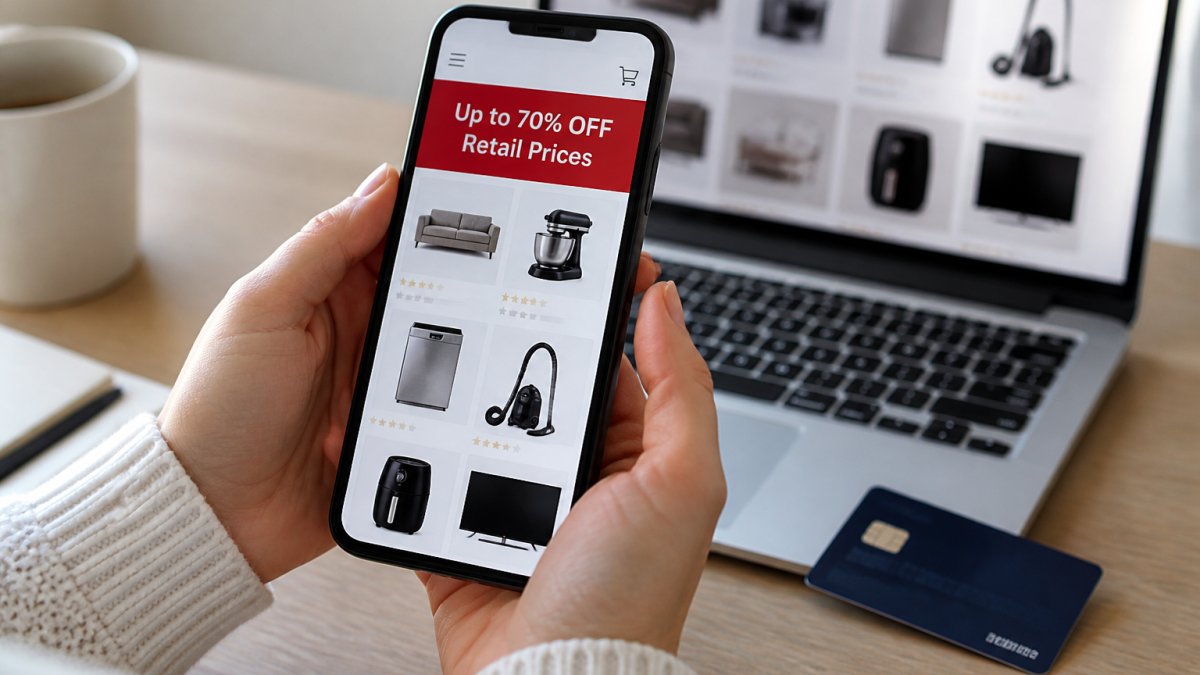
Close-up of a person’s hands holding a smartphone showing an online store with a steep discount banner, with a laptop and credit card on a table in the background
Prices That Are Unusually Low
The first online shopping scam red flag is a price that sits far below every other seller. Real discounts have a reason behind them: a discontinued model, a seasonal clearance, a dented box. Fake discounts have no reason at all.
Ask yourself three questions:
Does the seller explain why the price is low?
Is the same item sold elsewhere for much more?
Does the listing skip photos of the actual item?
If the answer to the last question is yes, walk away. A real seller shows the product.
High-Pressure Sales Tactics and Countdown Timers
Pressure is a tool, not a courtesy. Countdown timers that reset when you refresh the page, “only 2 left” warnings that never change, and pop-ups begging you to hurry are all signs of a fraudulent offer.
Legitimate stores run limited-time offers too. The difference is honesty. A real sale ends when it says it ends.
Watch Out A timer that resets after it hits zero is a scripted trick, not a deadline. If you see it, close the tab. Stores that rely on fake urgency rarely ship what you ordered.
How to Verify a Website’s Authenticity Before You Buy
You verify a website’s authenticity by checking three things: the domain, the contact details, and the track record. Each takes under a minute. Together they catch most suspicious websites before you enter payment information.
Check the URL and Domain Name
Look at the address bar, not the logo. Scammers copy logos and layouts in minutes. They cannot copy a domain.
Watch for these tells:
A misspelled URL, like “amaz0n” or “walmrt”
Odd endings such as “.shop” or “.top” on a store claiming to be a major brand
No padlock icon, or a browser warning about the secure connection
A domain registered weeks ago, which you can check with a free lookup tool
Type the store’s name into a search engine and compare the result to the address bar. If they don’t match, stop.
Look for Business Contact Details and a Physical Address
A real business publishes a phone number, an email address, and a mailing address. Fake storefronts often list none, or list a address that turns out to be an empty lot.
Check for these:
A contact page with more than a form
A physical address you can look up on a map
A company name that matches the domain
A return policy written in plain language
The Federal Trade Commission’s guidance on avoiding scams puts it simply: if a seller hides who they are, that is your answer.
How to Spot Fake Online Deals in Social Media Ads and DMs
Fake online deals spread fastest through social media ads and direct messages, but the two channels fail in different ways. An unsolicited offer in your inbox is the single most common entry point. Real brands do not slide into your DMs with a clearance link. Ads, by contrast, can appear inside a platform you trust, which is exactly why they work.
Tap the ad’s profile and check when the account was created and whether it has a real posting history
Look at the destination URL in the ad preview, not the display name, a brand name in the text means nothing if the link goes elsewhere
Read the comments: identical praise, copied complaints, or comments disabled are all tells
Reverse-image search the main product photo; stolen photos appear on many unrelated stores
Check whether the same promotion appears on the brand’s official website or verified account
Email offers
Hover over every link and read the actual destination domain before clicking
Check the sender’s full address, not just the display name, a real brand’s mail comes from its own domain
Be wary of attachments and of any message that asks you to “confirm” payment details
If the offer is real, you can reach it by typing the brand’s address yourself instead of using the email link
Direct messages and texts
Did you ask for this offer? If not, treat it as suspect
Real sellers do not request payment, gift card codes, or account passwords in a DM
A message that moves you off-platform to a chat app is a red flag, not a convenience
Check the account for follower history, posting history, and whether it mirrors a known brand
Search ads
Sponsored results can sit above the real store; compare the displayed URL to the brand’s known domain
Misspelled or hyphenated domains in ad copy are a common impersonation trick
Click through to the site and confirm the contact page and return policy exist before buying
Fake ads often use outdated logos and stolen product photos. Reverse-image search the main photo. If it appears on ten other stores, it isn’t theirs. The same photo test works across every channel above.
Pro Tip When an offer reaches you first, verify it second. Open a new tab, type the brand’s address yourself, and see whether the deal exists on the official site. If it doesn’t, you have your answer without ever clicking the link.
Verify the Discount With Historical Price Data
A genuine discount shows up in the price history. A fake one only exists on the page you’re looking at. Price tracking tools record what an item actually sold for over weeks or months, so you can see whether the “sale” price is really a cut.
Here’s the check:
Paste the product link into a price history tool
Look at the lowest price in the past 90 days
Compare it to the “discounted” price today
If today’s price matches the usual price, the discount is theater. Some sellers raise the list price right before a sale to make the markdown look bigger. The history exposes it in seconds.
Pro Tip Screenshot the price history before you buy. If the item arrives damaged or not at all, that record helps when you dispute the charge with your card issuer.
Secure Payment Methods for Online Shopping
Secure payment methods for online shopping share one trait: they give you a way to get your money back. A credit card, for example, lets you dispute a charge for goods that never arrive. A wire transfer or gift card code gives you nothing. The payment method is only half the job, though, the checkout page and what you do after a bad charge matter just as much.
Choose a payment method with recourse
Pay by credit card or a card-backed digital wallet
Avoid debit cards for unfamiliar sellers; the dispute process is weaker than a credit card’s
Never send payment through a DM, text, or gift card
Decline any request to pay by wire, crypto, or peer-to-peer transfer
Check the checkout page before you type
Confirm the address bar shows the seller’s real domain and a secure connection
Look for a checkout that stays on the seller’s site rather than redirecting to an unrelated payment page
Read the total before submitting, added fees or a changed currency are a warning
Confirm the merchant name that will appear on your statement matches the store
Save the order confirmation, receipt, and a screenshot of the listing you bought
Watch Out No legitimate store asks for payment by gift card, wire, or crypto. That request is the scam, no matter how good the deal looks.
If the item never arrives or isn’t as described
Act the same day you realize something is wrong, because card issuers set deadlines for disputes.
Contact the seller in writing and ask for a refund; keep the reply
Dispute the charge with your card issuer and cite the saved listing and receipt
Report the store to the platform that hosted the ad or listing
File a report at ReportFraud.ftc.gov
Change any passwords you shared during checkout and review your statements for repeat charges
Documentation is what makes a dispute succeed. The screenshots you took at checkout are the evidence the issuer will ask for.
Before you buy from an unfamiliar seller, confirm the listing shows real photos of the actual item and a full condition description. A listing that skips both is telling you something before you ever reach the payment page.
Reporting Online Shopping Fraud to the FTC and Other Steps After a Bad Purchase
Reporting online shopping fraud to the FTC is free and takes minutes at ReportFraud.ftc.gov. Do it even if you think the money is gone. Your report feeds a database that law enforcement uses to spot patterns.
Then work through these steps in order:
Contact the seller in writing and ask for a refund
Dispute the charge with your card issuer
Report the store to the platform that hosted the ad
File your report with the FTC
Change any passwords you shared during checkout
Speed matters. Card issuers set deadlines for disputes, so start the same day you realize something is wrong.
Conclusion
Fake deals thrive on speed and silence. Slow down, check the domain, read the price history, and pay only with a method that protects you. When you want discounted goods without the guesswork, shop with The Wise Buy. We inspect every item, publish detailed photos and full condition notes on each listing, and stock trusted brand names at a fraction of retail. Create an account today and shop open-box and overstock deals with confidence.
Frequently Asked Questions
How can you tell if an online shopping website is legitimate?
Check the domain name for misspellings, look for a secure connection, and confirm the seller lists a physical address and business contact details. Search the business name alongside words like ‘scam’ or ‘reviews’ to see what other shoppers say. A legitimate site will also have a clear return policy and real customer reviews, not just generic five-star ratings posted in bursts.
What should you do if you suspect you bought from a fake website?
Contact your payment provider immediately to dispute the charge and ask whether you can cancel the transaction. Change any passwords you used on the site, especially if you created an account. Then file a report at ReportFraud.ftc.gov. Keep screenshots of the listing, the order confirmation, and any messages from the seller, since those records support your dispute.
Why do scammers use too-good-to-be-true pricing?
An unusually low price creates urgency and shuts down careful thinking. Scammers count on shoppers grabbing a deal before checking the seller’s reputation or the site’s history. If a brand-name item is listed far below what every other retailer charges, treat that gap as a warning sign and verify the offer before entering payment information.
Are secure payment methods enough to protect you from fake deals?
They help, but they are not a guarantee. Credit cards and established payment services offer dispute processes, which gives you a way to recover money if goods never arrive. Wire transfers, gift cards, and payment apps with no buyer protection leave you with little recourse. Use a payment method with a paper trail and avoid any seller who insists on an unusual method.

 Add more eligible items to your cart to unlock free shipping.