Open box appliances are items a customer bought, returned unopened or barely used, and that a retailer then resells at a discount after inspection. The open box label describes the packaging, not the condition: the box may be dented, taped, or missing, while the appliance inside works normally.
Most returns happen for reasons that have nothing to do with defects. That is why open box stock often includes current-year models with full manufacturer warranty coverage still attached.
The Wise Buy tests and inspects every item before it is listed, then publishes detailed photos and a full condition description on each posting. That matters, because in this category you are buying the specific unit shown, not a generic promise. Below, we break down real savings, warranty differences, and an inspection checklist you can use.
Key Takeaway Open box means packaging was opened, not that the appliance was used hard. The unit’s actual condition is documented per listing, so read the posting before you compare prices.
How Much Can You Save on Open Box Appliances?
Savings on open box appliances typically run well below the original retail price, with the deepest discounts on discontinued finishes, floor models, and units with cosmetic damage. A scratch on a side panel that faces a cabinet costs you nothing in performance but can cut a meaningful amount off the price.
Where the discount lands depends on four things:
Condition grade: flawless units sell closest to retail; scratch-and-dent units sell lowest
Missing accessories: a missing manual is trivial, a missing installation hardware kit is not
Age of the model: last year’s smart features still work, but inventory turnover pushes prices down
Season: appliance promotions cluster around holiday weekends, when clearance stock moves fastest
One caution: a low price point is not automatically a good deal. Compare the open box price against the current sale price of the same model new, not against the manufacturer’s list price.
The Wise Buy lists current pricing on each product page, so check the posting for the exact figure.
Open Box vs Refurbished Appliances: What’s the Difference?
Open box and refurbished appliances differ in who touched the unit and why. An open box item was returned by a customer, usually with minimal or no use. A refurbished item was sent back to the manufacturer or a refurbisher, repaired or reconditioned, and then recertified for resale.
The term certified refurbished means the unit passed a manufacturer’s recertification program. That is a stronger guarantee than an unverified pre-owned listing. If condition matters more than the absolute lowest price, open box is the safer bet.
Watch Out A “refurbished” label without a named certifying program tells you almost nothing. Ask who performed the work and what warranty backs it before you buy.
How to Inspect Open Box Appliances Before You Buy
Inspection is where most buyers either protect themselves or get burned. When you buy online, your inspection happens entirely through the listing: the photos, the condition notes, and the seller’s testing claims. You cannot open the door or run a cycle before checkout, so the quality of the posting is your only substitute for a physical walkthrough.
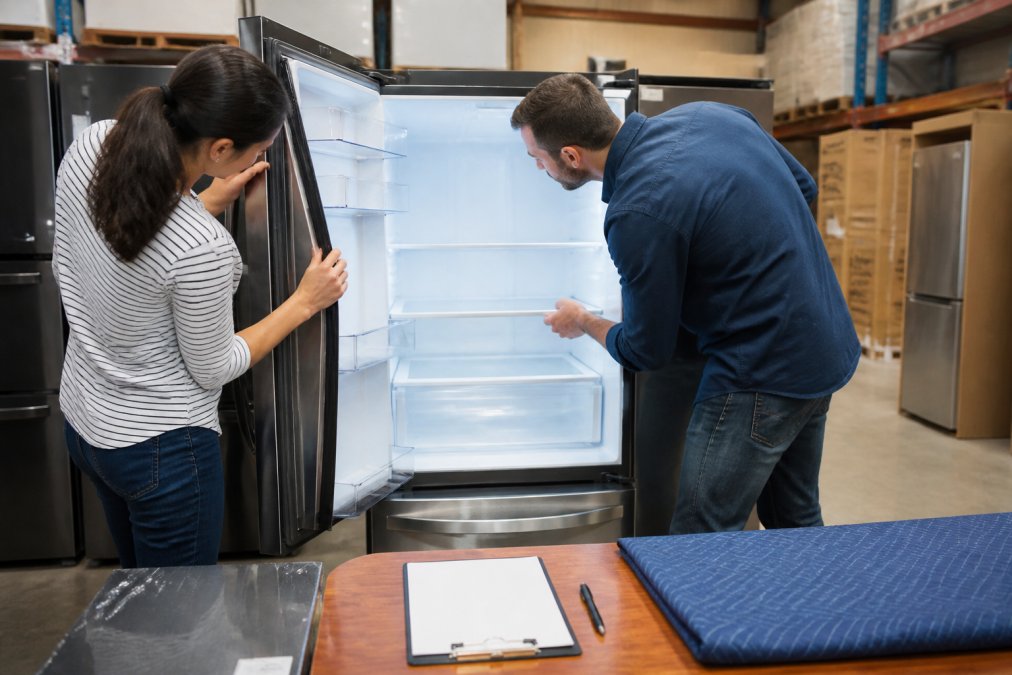
Shoppers inspecting the door seal and shelves of open box appliances in a warehouse using a printed checklist.
Start with the listing itself. A thorough posting should show the unit from multiple angles, including any damage, and describe the condition in plain language. If a listing shows only a stock photo or a single wide shot, that is a signal to ask for more before you commit.
Run this checklist against the posting before you buy:
Confirm the serial number is visible in the photos and matches the description
Look for cosmetic damage: dents, deep scratches, cracked trim, discolored panels
Check whether original packaging and installation hardware are included or noted as missing
Read the condition notes for door, drawer, and hinge alignment issues
Look for evidence of functional testing: burners, ice makers, control panels, interior lights
Verify energy efficiency ratings and smart features are described as working
Confirm the return window and warranty path are stated in the posting
For delivery damage, photograph the unit before signing anything.
Pro Tip If the posting does not show the serial number or describe the condition in detail, ask before you buy. A seller who documents each unit will answer quickly; one who does not is telling you something.
Open Box Appliance Warranty Coverage: What You Need to Know
Open box appliance warranty coverage depends entirely on how the item was sold, not on the fact that the box was opened. Many open box units still carry their full manufacturer warranty because the original purchase date starts the clock and the unit was never registered by a prior owner.
Full manufacturer warranty – the unit was returned unregistered, so you get the standard term
Remaining manufacturer warranty – the original buyer registered it, so you inherit what is left
Seller-backed coverage – the retailer or a third party covers the unit instead
An extended service plan can fill the gap when manufacturer coverage is short or absent. Read the terms before you buy: some plans exclude cosmetic damage, and some require you to keep the receipt as proof of purchase.
Consumer rights vary by state, and the FTC’s guidance on warranty and consumer protections explains what sellers must disclose about coverage. If a listing is vague about warranty, treat that as a signal to ask questions before you pay.
The Hidden Costs of Open Box Appliances
The sticker price is rarely the full cost. Hidden costs show up after delivery, and they can erase your savings if you do not plan for them.
Delivery and haul-away: moving a refrigerator or range is not a parcel shipment
Installation: gas lines, water hookups, and venting often need a licensed technician
Missing parts: replacement shelves, racks, and hardware kits add up fast
Repairs outside warranty: a single service call can outweigh a modest discount
Extended service plan premiums: worth it for some appliances, wasted money for others
Budget for these before you decide the discount is worth it. A budget-friendly price on a unit that needs a new water line and a technician visit is not the same as a bargain.
Pro Tip Ask whether the original accessories, manual, and hardware are included before checkout. Replacing a missing installation kit on a built-in appliance often costs more than the discount you negotiated.
Which Appliances Are Worth Buying Open Box (and Which Aren’t)
Some appliances are excellent open box candidates. Others carry risk that outweighs the savings, and knowing the difference is the whole game. The key is not the appliance type alone but how easy it is to verify condition remotely and how expensive a failure would be.
A simple risk framework helps: if the appliance is easy to test, easy to return, and covered by a manufacturer warranty, open box is low risk. If any of those three is missing, slow down.
Lower-risk open box purchases:
Refrigerators and freezers: simple mechanics, easy to verify with photos of the interior and door seals
Ranges and ovens: cosmetic damage is common and rarely affects cooking performance
Dishwashers: straightforward to assess from a cycle description and interior photos
Washers and dryers: high inventory turnover means frequent open box stock and more listings to compare
Higher-risk open box purchases:
Built-in appliances with custom cabinetry cuts, where a fit issue is expensive to correct
Units with sealed systems you cannot verify without a technician
Smart appliances whose connectivity depends on discontinued app support
Anything sold without a serial number or proof of purchase
Negotiation tactics that work: ask about floor model status, offer to skip delivery for a pickup, and buy multiple open box items together. Sellers move inventory faster when a single order clears several units. If an item has been listed for a while, ask whether the price is flexible; a unit that has not moved is costing the seller space.
That is where buying from a seller who documents each unit pays off. The Wise Buy photographs every item and publishes the full condition and description on the posting, so you can assess the specific unit before you commit.
Frequently Asked Questions
Do open box appliances come with a manufacturer warranty?
It depends on the retailer and the item. Some open box appliances retain the full manufacturer warranty because they were never registered or used. Others are sold as-is with only a short store return window. Always ask for the warranty status in writing and keep your proof of purchase. If the listing does not state warranty coverage clearly, treat it as no warranty and factor that risk into your decision.
Is it better to buy open box or refurbished?
Open box items are typically unused returns with original packaging and accessories, so they carry less repair risk. Refurbished units have been inspected, repaired, and tested, which can mean better reliability but also more wear history. For appliances with few moving parts, open box is usually the safer bet. For complex items like washing machines, a certified refurbished unit with a written warranty may offer more peace of mind.
What should I look for when inspecting an open box appliance?
Check the serial number against the listing, confirm all installation hardware and accessories are present, and test every function: doors, seals, knobs, lights, and cycles. Look for cosmetic damage like dents, scratches, or delivery damage. Ask whether the unit was a customer return or a floor model, and request photos of the actual item. Buy only from sellers who post detailed pictures and condition notes.
How much can you typically save on open box appliances?
Savings vary widely by category, brand, and condition. Open box appliances often sell for less than the discounted retail price you would see on a new unit, with deeper cuts on floor models and discontinued inventory. The biggest savings tend to appear on high-retail-markup categories like refrigerators and ranges. Compare the open box price against current new pricing before buying, and factor in any missing accessories or extended service plan costs.

 Add more eligible items to your cart to unlock free shipping.