Homepage How to Choose Lingerie That Fits and Feels Right
Last Updated: November 10, 2026
Quick Summary
To choose lingerie, start by fit and construction rather than the label. Decide between separates you can mix and match and one-piece styles like bodysuits or teddies, then measure your band and bust with a soft tape to find a starting size.
Measure the band under the bust, rounding to the nearest inch, then move to the next even number if needed.
Subtract the band measurement from the bust measurement; each whole inch equals one cup letter.
Check that the band is level and carries most support, and the cups contain all breast tissue without gaping.
Wash elastic pieces in cool water, skip fabric softener, and dry flat or on a no-heat setting.
Re-measure periodically, since weight changes, pregnancy and age can all alter your size.
Lingerie is one of the few wardrobe categories where the right cut matters more than the label, so it pays to choose lingerie by fit and construction first. The main styles fall into two families: separates you can mix and match, and one-piece garments that do the work of several pieces at once. Knowing which family suits your body and your plans is the fastest way to narrow a shopping list.
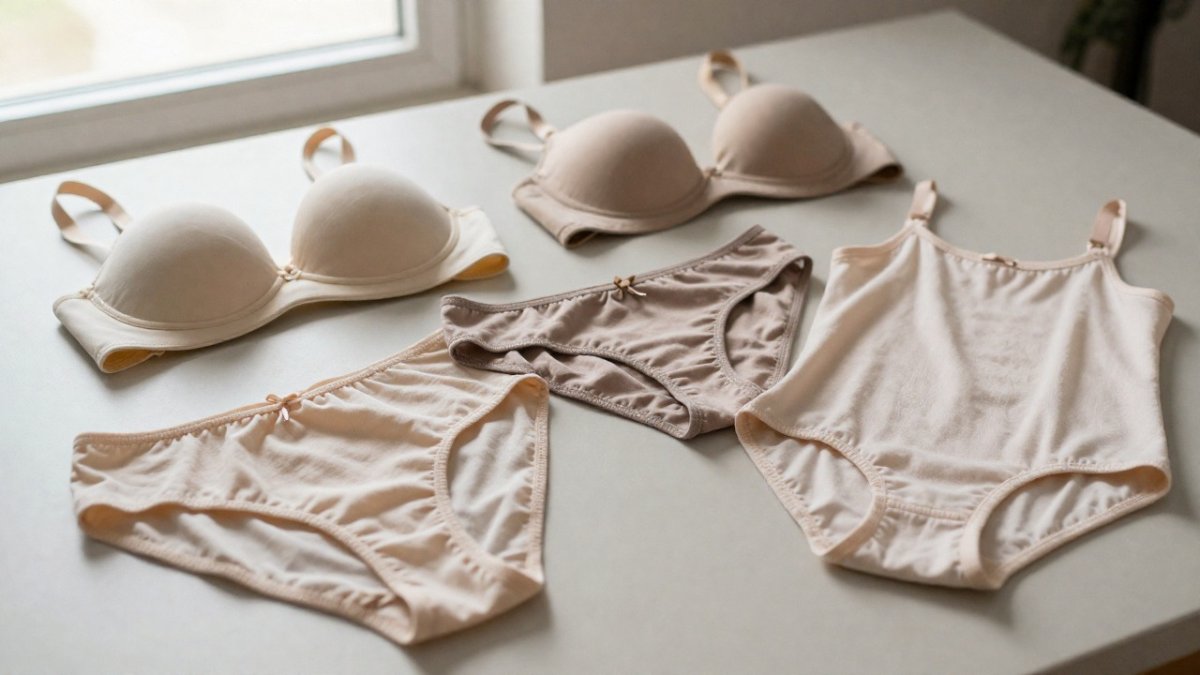
Flat-lay of a bra, panties, bodysuit, and babydoll to help you choose lingerie in different styles.
Bras, Panties, and Coordinated Sets
Bras and panties remain the foundation of most drawers. A coordinated set puts a matching bra and bottom in the same fabric and colour, which keeps the look consistent under clothing. Separates let you buy a bra that fits well and then pick bottoms for the cut you prefer, which is often the more practical route if your bra size is harder to find.
Bodysuits, Teddies, Corsets, and Babydolls
These one-piece styles skip the question of whether the top and bottom match. A bodysuit is typically close-fitting and works under or instead of a top. Teddies add a bra-like structure to the bottom half. Corsets and bustiers offer structured support and shape, while babydolls are lighter, looser nightwear built around a short, flowing silhouette. When you choose lingerie in these styles, decide by how much structure and coverage you want, not by how the style looks on a model.
How to Measure Bra Size at Home
A home measurement gives you a reliable starting size if you take it the same way each time. Use a soft, flexible tape, not a rigid ruler, and measure over a non-padded bra or bare skin while standing upright and breathing normally.
Start with the band. Wrap the tape around your ribcage directly under the bust, keeping it level at the back. The tape should be snug enough that it does not slip, but you should be able to slide one finger underneath it. Breathe out before you read the number. Round to the nearest whole inch, then, if the result is an odd number, move to the next even number, because band sizes are sold in even increments.
Next, measure the bust. Wrap the tape around the fullest part of your bust, keeping it parallel to the floor and not pulled tight. Round this number to the nearest whole inch.
To find the cup, subtract the band measurement from the bust measurement. Each whole inch of difference corresponds to a cup letter, starting with A for one inch, B for two inches, C for three inches, and so on. A difference under one inch is usually treated as AA, and differences above the common range are typically handled by the brand’s own chart, since cup progressions vary between manufacturers.
Check the fit before you trust the result. The band should sit horizontal and carry most of the support, not the straps. The cups should contain all breast tissue with no spilling at the top or sides and no gaping at the neckline. The center gore should lie flat against the sternum. If the straps dig in, the band rides up at the back, or the underwire sits on breast tissue rather than around it, try a band one size smaller and a cup one size larger, or the reverse, depending on which problem you see.
Sizing changes over time with weight shifts, pregnancy, and age, so measure again periodically. Because each brand cuts its cups differently, compare your numbers against the brand’s own size chart on the product page before ordering, and use the fit checks above to decide between neighbouring sizes.
The steps below summarise the measuring process so you can check each one at a glance.
Step
What to do
Note
Band
Wrap soft tape under bust, level at back
Breathe out before reading
Band rounding
Round to nearest inch, then to even number
Band sizes use even increments
Bust
Wrap tape around fullest part of bust
Keep parallel to floor, not tight
Cup
Subtract band from bust measurement
Each inch equals one cup letter
Fit check
Confirm band, cups and gore fit
Adjust band or cup size if needed
Re-measure
Measure again periodically
Weight, pregnancy and age change size
Fabrics and Construction: What Feels Best
Fabric changes both comfort and longevity. Cotton is breathable and gentle for everyday wear. Nylon and spandex blends stretch and recover well, which suits fitted pieces. Silk and satin feel luxurious but need more careful handling. Lace adds texture but is often a decorative layer rather than a supporting one. Look at construction too: seams that lie flat, adjustable straps, and a band that holds its shape usually predict a better fit over time.
Choosing Lingerie for Everyday, Occasion, and Special Needs
Everyday lingerie should prioritise breathability, a smooth profile under clothing, and a band that stays put through a full day. For occasions, structure and colour carry more weight, and a set chosen for a specific outfit makes sense. If you have sensitive skin, need post-surgical or adaptive pieces, or require extended sizing, look for soft seams, wide and adjustable straps, and fastenings that are easy to manage. Brands differ widely here, so read product details carefully before buying.
Lingerie Care, Washing, and Storage
Care depends mostly on fabric and construction. A cotton bralette and a silk-and-lace teddy need different handling, and most early wear-out comes from heat, friction, and fabric softener rather than from the wash itself.
For elastic-heavy pieces such as bras, bikini bottoms, and shapewear, the elastic is the first thing to fail. Heat breaks down spandex fibres, so wash in cool or lukewarm water and dry flat or on a no-heat setting. Fabric softener coats elastic and reduces its grip, which is why it shortens the life of a well-fitting bra. Skip it and use a small amount of mild detergent instead.
Bras need a few specific steps. Fasten the hooks before washing so they do not snag other garments or stretch the band. Put them in a mesh bag, on a delicate cycle or by hand. Dry them flat on a towel or hang them by the band, never by the straps, since a wet strap stretched over a hanger loses its shape. Replace the bra when the band no longer holds against your ribcage or the underwire begins to poke through.
Silk and satin should be hand washed in cool water with a gentle detergent, rinsed without wringing, and dried flat away from direct sun, which fades dyes and weakens protein fibres. Lace can be hand washed or placed in a mesh bag, but avoid rough handling of decorative edges, which snag easily. Cotton is the most forgiving fabric and tolerates a standard gentle cycle, though it still benefits from air drying.
Storage matters as much as washing. Fold or roll garments rather than hanging them stretched, and avoid folding a bra in half over its underwire, which can bend the wire permanently. Rotate pieces through your rotation so elastic recovers between wears, and keep lingerie away from sharp objects, zippers, and hook-and-eye closures that can catch and pull threads in a drawer.
Watch out: chlorine and high-heat tumble drying are the two fastest ways to ruin elastic, so keep swimwear-style lingerie away from pool water and never use the hot setting of a dryer.
Buying Lingerie Online With Confidence
Shopping online works well when you know what to check. Compare the size chart against your own measurements rather than relying on your usual size. Read the product description for fabric content and construction details, and review the photos for how the piece lies and fastens. Because sizing varies, check the return and exchange terms on the listing before you buy. Full product descriptions, photos, and the stated condition are on each item’s listing on our website, so review those before you order.
Frequently Asked Questions
What are the different types of lingerie?
Lingerie covers bras, panties, coordinated sets, bodysuits, teddies, corsets, bustiers and babydolls. Everyday styles like full-coverage bras and brief-cut underwear focus on support and comfort, while teddies, corsets and babydolls are usually chosen for occasions. Start by deciding what you need the piece to do, then narrow the style. Most shoppers find that one or two everyday sets and one occasion piece cover most needs.
How do I measure myself for a bra?
Measure your underbust snugly with a soft tape, then measure around the fullest part of your bust. Round the underbust to the nearest whole number, and subtract it from the bust measurement to find your cup size difference. Check the brand’s size chart, since sizing varies between manufacturers. Re-measure every few months, because body changes can shift your fit.
Which lingerie fabrics are most comfortable?
Cotton and modal are breathable and suit daily wear. Lace adds style but can scratch, so look for a lined version for comfort. Silk and satin feel smooth and luxurious but need gentle care. Stretch blends with elastane give flexibility and support. Choose based on how you plan to wear the piece.
What should I look for when buying lingerie online?
Check the product photos, the full description and the stated condition before ordering. Compare the size chart with your own measurements rather than relying on your usual size. Read the fabric details and care instructions. Confirm the return and exchange terms on the listing so you know what to expect if the fit is off.

 Add more eligible items to your cart to unlock free shipping.