Where to Buy Cheap Brand Name Goods: The Short Answer
The fastest route to cheap brand name goods is a mix of off-price retailers, department store clearance racks, and open-box or overstock sellers that publish real photos of the exact unit you’re buying.
The gap between the sticker price and what you pay comes down to one thing: how the seller handles past-season merchandise. Outlet stores, off-price retailers, and clearance sections all move the same goods through different channels, and each channel carries its own risk. Knowing which is which saves you from paying a discount price for a damaged item.
Three things matter more than the advertised percentage off:
Condition disclosure. A listing with close-up photos of the actual unit beats a stock photo every time.
Total cost. Shipping, tax, and return fees can erase a headline discount.
Authenticity signals. Genuine products come with verifiable brand tags, serial numbers, or model codes.
That last point is where most guides stop short. We’ll show you how to check all three before you commit.
Best Online Retailers for Discounted Brand-Name Products
Online retail is where discounted apparel and home goods compete hardest on price, and the winners are usually the sellers who show you the item rather than describe it in adjectives. The retailers below fall into two groups: off-price sellers built around designer fashion, and comparison tools that surface deals across many stores.
Outlet Stores and Off-Price Retailers
Off-price retailers buy past-season merchandise and overstock directly from brands, then sell it below the original retail price. Federal Trade Commission guidance on pricing and discounts explains how “original” and “sale” prices must be substantiated, which is worth knowing when a listing claims an enormous markdown.
Bluefly is an online outlet focused on discounted designer fashion, including shoes and handbags, with a broad catalog of luxury brands and styles. Saks OFF 5TH runs a similar model, mixing everyday apparel with high-end designer pieces at lower prices than its full-line parent store. Both are worth checking when you want designer fashion without the department store markup.
The trade-off: neither publishes the condition history of an individual item the way an open-box seller does. You’re buying new, but you’re buying whatever inventory the buyer happened to secure.
Department Store Sale Sections and Clearance
Department store clearance is the most predictable discount channel, because the markdown schedule follows the retail calendar. Seasonal sales clear past-season merchandise on a fixed rhythm: winter apparel drops after the holidays, summer goods clear in late summer, and home goods get marked down when new collections arrive.
The catch is availability. Clearance inventory is what’s left, in the sizes and colors nobody else wanted. If you need a specific size or a matching set, clearance is a gamble. If you’re flexible, it’s the cheapest legitimate route to name-brand products.
Pro Tip Shop clearance at the end of a season, not the start. Retailers cut prices in stages, and the deepest markdowns land in the final weeks before new stock arrives. Check the same listing weekly rather than buying at the first discount.
Open-Box Appliances: What You Actually Get
Open-box appliances are items returned, display models, or overstock units that were never used, sold at a discount because the packaging is open or the box is damaged. The appliance itself is typically in working condition, but the condition varies by seller and by unit.
This is the category where disclosure separates good sellers from bad ones. A returned item can carry a scratch, a missing accessory, or a dented panel, and the only way to know is what the seller tells you. That’s why we publish detailed photos and full condition descriptions on every listing, so you can see the exact unit before you buy. We test and inspect each item, and the photos show what the inspection found.
What to look for in any open-box appliance listing:
Photos of the actual unit, not manufacturer stock images
A written condition note naming any cosmetic flaws
Confirmation that all original accessories are included
The model number, so you can verify specs and warranty terms
The brand’s warranty policy for open-box purchases
Watch Out Never buy an open-box appliance from a listing that shows only stock photos. If the seller won’t show the actual unit, you have no way to know whether the “open box” is a display model or a return with hidden damage. Ask for photos or walk away.
Overstock Products Online: Where the Real Markdowns Are
Overstock products online are excess inventory that retailers and manufacturers couldn’t sell through normal channels, sold at a discount to clear warehouse space.
The pattern is worth understanding. When a brand discontinues a model or a retailer over-orders, that inventory has to go somewhere, and it usually moves to off-price sellers rather than back to the manufacturer.
Our take: use a comparison tool to find the price floor, then check the seller’s condition disclosure before you buy. A slightly higher price from a seller who shows the actual unit is usually the better deal.
How to Check Product Condition Online Before You Buy
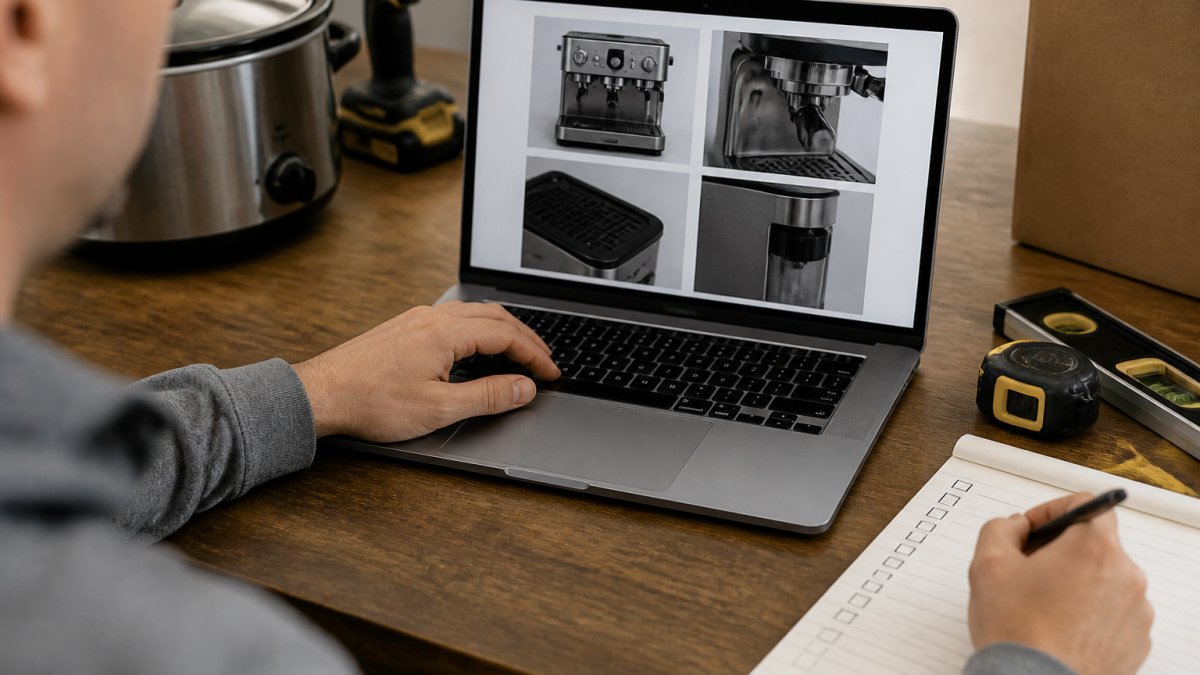
Checking product condition online means reading three things: the seller’s written condition description, the photos of the actual unit, and the return policy that covers you if the item doesn’t match. Skip any one of them and you’re guessing.
A person sitting at a desk with a laptop, examining a product listing page with close-up photos of an appliance on screen, a notepad with a checklist beside the keyboard
Photos, Descriptions, and Inspection Details
The photos should show the item from multiple angles, including any flaw the seller has already noted. If the description says “minor scuff on the left panel,” the photos should show that scuff. A listing that mentions flaws but doesn’t photograph them is asking you to trust a sentence.
The description should also state what’s included. Open-box items sometimes arrive without the manual, the accessory kit, or the original packaging, and that’s fine as long as it’s disclosed. What isn’t fine is discovering a missing part after delivery.
Here’s the checklist we’d run through before buying any discounted item online:
Does the listing show photos of the actual unit?
Does the condition note name every cosmetic flaw?
Is the model number listed so you can verify specs?
Are all included accessories and parts listed?
Is the return window and process stated clearly?
Does the brand warranty still apply to this purchase?
Key Takeaway The single most useful habit when buying discounted goods online: verify the unit, not the category. A listing that shows you the exact item you’ll receive removes almost all of the risk that comes with a discount.
Category Guide: Clothing, Footwear, Accessories, and Home Goods
Discount strategy changes by category, because the resale channels are different for each. Clothing and footwear move through off-price retailers and department store clearance, while home goods and electronics move through overstock and open-box channels.
For men’s clothing, women’s clothing, and children’s clothing, off-price retailers and department store clearance are the strongest options.
For footwear and shoes, outlet stores carry past-season styles at lower prices, and the fit risk is higher than apparel because sizing varies by brand.
For accessories, including handbags and small leather goods, off-price designer retailers are the best fit. Authenticity matters most here, so look for brand tags, serial numbers, and stitching quality in the photos.
For home goods and electronics, overstock and open-box sellers offer the deepest markdowns. Condition disclosure is the deciding factor, which is exactly why we photograph every unit we list.
Category
Best Channel
Main Risk
What to Check
Clothing
Off-price, clearance
Sizing
Size chart, return policy
Footwear
Outlet stores
Fit variance
Easy returns, shipping cost
Accessories
Off-price designer
Authenticity
Tags, serial numbers
Home goods
Overstock, open-box
Condition
Photos of actual unit
Total Cost Comparison: Shipping, Returns, and Handling
The advertised discount is not the price you pay. Shipping, sales tax, and return fees all change the final number, and a lower sticker price can lose to a higher one once those costs land.
Shipping is the first variable. Some sellers fold it into the price, others add it at checkout, and heavy items like appliances cost more to move.
Returns are the second variable. A generous return window with free return shipping is worth paying a little more for, especially on footwear and apparel where fit is uncertain.
Taxes apply based on where you ship, and they’re calculated on the order total, so a higher shipping charge also raises the tax you owe.
Price Tracking and Sale Timing: When Discounts Peak
Discounts peak on a predictable calendar, and timing a purchase around it beats hunting for a coupon. Retail markdowns follow seasonal sales cycles, and the deepest cuts land when retailers need to clear space for new inventory.
The pattern that matters most:
End of season. Winter apparel clears after the holidays, summer goods clear in late summer. This is when past-season merchandise hits its lowest price.
Post-holiday. Returns and overstock from the gift season flood the market in January, which is a strong window for electronics and home goods.
Model transitions. When a brand discontinues a model, the remaining inventory gets discounted. This is the best time to buy appliances and tools.
Clearance final weeks. Retailers cut prices in stages, and the last markdown before new stock arrives is the deepest.
Price tracking tools help you catch these windows. Set a target price and check the listing weekly rather than buying at the first discount you see.
Our recommendation: if the item is a need and the price is already well below retail, buy it. If it’s a want, track it and wait for the seasonal window.
Finding cheap brand name goods isn’t about chasing the biggest advertised discount. It’s about buying from a seller who shows you the actual item, states its condition plainly, and backs the sale with a clear return policy.
Frequently Asked Questions
Where can I buy cheap brand name goods online with free shipping?
A few retailer types tend to offer free shipping on cheap brand name goods: off-price outlets, overstock sellers, and department store clearance sections often bundle shipping into orders above a threshold. Always check the shipping policy before checkout, because a low item price with a high shipping fee can erase your savings. Some price-comparison tools also flag stores that include free delivery, so you can filter by total cost rather than sticker price alone.
How can I tell whether discounted brand-name products are genuine?
Look for listings that show clear, close-up photos of the actual item, including labels, serial numbers, and packaging. Genuine discounted brand-name products usually come with original tags, model numbers that match the manufacturer’s site, and a stated condition (new, open-box, or overstock). If a seller hides the brand name, uses stock photos only, or refuses to confirm the model number, treat it as a red flag and move on.
What should I check before buying open-box appliances?
Before buying open-box appliances, confirm the condition grade (cosmetic scratches vs. functional issues), whether all original parts and manuals are included, and what the return window covers. Read the full description and look at the photos of the exact unit, not a generic image. Ask whether the item was tested, and check the warranty terms. A seller that publishes inspection notes and detailed photos makes this decision far easier.
How do I compare the condition of discounted products before ordering?
Start by reading the condition description on each listing. Terms like ‘new’, ‘open-box’, and ‘overstock’ mean different things: new is unused, open-box has been opened but typically unused, and overstock is surplus inventory. Compare photos side by side, note any disclosed damage, and check whether accessories are included. When a listing shows the actual unit and states what was inspected, you can compare condition across sellers with more confidence.
Where can I find discounted brand-name home goods and kitchen appliances?
Overstock and open-box sellers are the strongest source for discounted brand-name home goods and kitchen appliances, because they buy surplus inventory and returns in bulk. Off-price retailers and department store clearance sections also carry small appliances and cookware, especially after seasonal sales. Before ordering, verify the condition, confirm the model number, and check the return policy. Detailed photos and full descriptions on the listing are your best guide to what you’ll actually receive.

 Add more eligible items to your cart to unlock free shipping.